Back to Blog

National Taiwan University’s Fatty Acid Serum for Hair Loss: What the Data Actually Shows (and What It Doesn’t)

Researchers at National Taiwan University published a study in Cell Metabolism showing that a topical fatty acid formulation can regrow hair in mice by activating dormant hair follicle stem cells. The mechanism is tremendously well studied. The headlines were predictable. Here’s what the evidence actually shows, and the hard questions the paper doesn’t answer.
By Andrew Verbinnen30 Mar 2026Medically reviewed by Dr. Blake Bloxham, MD
National Taiwan University’s Fatty Acid Serum for Hair Loss: What the Data Actually Shows (and What It Doesn’t)

What did the NTU team actually discover?

  • In October 2025, a team led by Professor Sung-Jan Lin at National Taiwan University’s Department of Biomedical Engineering published “Adipocyte lipolysis activates epithelial stem cells for hair regeneration through fatty acid metabolic signaling” in Cell Metabolism, a top-tier journal. The paper maps out a previously unknown pathway connecting skin injury, fat cell metabolism, and hair follicle stem cell activation.

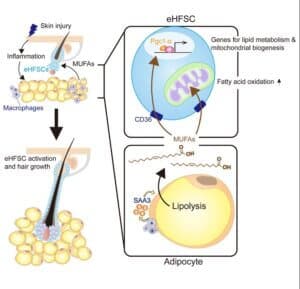
  • The core finding: when skin is injured, macrophages infiltrate the underlying dermal white adipose tissue (dWAT) and trigger fat cells to release free fatty acids through a process called lipolysis. Specifically, macrophages stimulate production of serum amyloid A3 (SAA3), which causes adipocytes to break down their stored triglycerides and release monounsaturated fatty acids (MUFAs), primarily oleic acid (C18:1) and palmitoleic acid (C16:1).

  • These MUFAs are then absorbed by epithelial hair follicle stem cells (eHFSCs) through the fatty acid transporter CD36. Once inside the stem cells, the fatty acids activate Pgc1-α, a master regulator of mitochondrial biogenesis. This triggers increased fatty acid oxidation and mitochondrial energy production, giving the dormant stem cells enough energy to exit quiescence and begin growing new hair.

  • Critically, the team showed that topical application of MUFAs alone, without any skin injury, was sufficient to activate hair follicle stem cells and promote hair regrowth in mice. Saturated fatty acids (palmitic acid, stearic acid) did not work. Only monounsaturated fatty acids triggered the regenerative response.

How strong is the evidence?

  • By the standards of basic science, this is high-quality work. It was published in Cell Metabolism (a top-tier journal), the team validated every step of the pathway independently, and blocking multiple nodes in the pathway suppressed hair regeneration. A patent has been filed by NTU and the raw data is publicly available.

  • That said, it is entirely a mouse study. The topical fatty acid formulation was applied to healthy mice with normal resting hair follicles for four days, producing visible regrowth within about 10 days. There were no human clinical trials, no dose-finding, and no long-term safety data. The only human data point is that MUFAs promoted growth of hair follicle cells in a dish, which is encouraging but extremely preliminary.

Why does injury make hair grow? The full cascade explained

  • The observation that skin injury promotes hair growth is not new. Dermatologists have known for decades that friction, insect bites, burns, vaccinations, and even orthopedic cast irritation can trigger local hair regrowth. Controlled skin inflammation, through chemical irritation or laser thermal injury, is already used clinically to treat hair loss (microneedling may overlap with some of these injury-response pathways). What has been missing is the molecular explanation for how superficial skin damage activates deeply situated hair follicle stem cells.

  • The NTU team’s model fills this gap with a three-stage cascade. First, skin injury triggers an inflammatory response that recruits macrophages into the dermal white adipose tissue. Second, these macrophages interact with adipocytes to induce SAA3 production, which triggers rapid lipolysis: fat cells break down their stored lipids and release free fatty acids into the surrounding tissue. Third, the released MUFAs are absorbed by hair follicle stem cells through CD36, activating Pgc1-α-dependent mitochondrial metabolism that provides the energy needed to exit quiescence.

  • The elegance of this model is that adipocytes act as relay cells, sitting between the surface injury and the deeply embedded stem cells, converting an immune signal into a metabolic one. The authors describe this as a “facultative niche”: adipocytes are not normally involved in regulating stem cells, but are recruited to do so on demand after injury.

Why only monounsaturated fatty acids?

  • The specificity finding is one of the most interesting results in the paper. The team tested five different fatty acids on cultured eHFSCs and on mouse skin: oleic acid (C18:1, monounsaturated), palmitoleic acid (C16:1, monounsaturated), palmitic acid (C16:0, saturated), stearic acid (C18:0, saturated), and linoleic acid (C18:2, polyunsaturated).

  • Only the two monounsaturated fatty acids (oleic and palmitoleic acid) promoted hair follicle stem cell colony formation in culture and hair regeneration when applied topically. Saturated fatty acids had no significant effect. Polyunsaturated linoleic acid actually killed eHFSCs in culture, suggesting cytotoxicity to stem cells.

  • The mechanistic explanation: MUFAs were far more effective at driving fatty acid oxidation for ATP production in stem cells. Oleic acid was the most potent, increasing ATP production primarily through enhanced mitochondrial respiration. Saturated fatty acids did not meaningfully increase ATP. Transcriptomic analysis confirmed that oleic acid upregulated oxidative phosphorylation and electron transport chain genes in eHFSCs, while stearic acid did not.

The question the paper doesn’t answer: does this work in androgenetic alopecia?

  • The NTU study used healthy mice with normal resting (telogen phase) hair follicles. These follicles are dormant but fully intact. Androgenetic alopecia (AGA) is a fundamentally different situation: follicles are being actively miniaturized by androgen signaling, not just resting.

  • There is reason to think the MUFA pathway may face resistance in AGA. TWIST1, a transcription factor upregulated in balding scalp, has been shown to suppress PGC-1α activity in other tissues. PGC-1α is the exact target MUFAs are supposed to activate. If TWIST1 is blocking PGC-1α in AGA follicles, adding more upstream signal may not help. This has not been directly tested in human scalp.

  • Adding to the uncertainty: PGC-1α transcript levels are actually elevated in miniaturized AGA follicles, not reduced. This may be a compensatory response, with the follicle trying to restore mitochondrial function while something else suppresses PGC-1α’s actual activity. Whether topical MUFAs could overcome that suppression is unknown.

  • The key question remains: can topical MUFAs awaken follicles that are further gone than normal resting ones? We do not know.

What about stem cell depletion?

  • The stem cell pool in the hair follicle is finite. Each time stem cells activate to grow a new hair, some differentiate into hair cells and some stay behind as stem cells for the next cycle. If you force activation too aggressively, more stem cells get used up than are replenished, and the reserve gradually shrinks. Once that reserve is gone, the follicle may lose the ability to produce hair permanently.

  • In mice, two months of forced cycling did not reduce the stem cell pool, but ten months did. Any treatment that chronically overrides stem cell quiescence could theoretically face this risk, though the threshold for depletion in humans is unknown.

  • The NTU study applied MUFAs for only four days and observed a single round of regrowth. That is very different from the years of continuous use a hair loss treatment would require. Long-term safety on stem cell reserves is completely uncharacterized.

What other context is missing from the paper?

  • The Randle cycle. Fatty acid oxidation and glucose oxidation compete with each other metabolically. Could a follicle’s metabolic state determine whether applied MUFAs actually get burned for energy or just stored as fat? The paper does not address this.

  • Your body already makes these fatty acids. The enzyme SCD1 naturally synthesizes oleic and palmitoleic acid, the exact MUFAs in this study. SCD1 is already known to be essential for hair follicle survival. The paper does not address whether AGA follicles have impaired SCD1 activity, or whether applying MUFAs externally can compensate if endogenous production is broken.

  • Mouse-to-human translation. The signaling molecule that triggers fat cell lipolysis in this study (SAA3) is expressed in mice but not in humans, who use related but distinct versions (SAA1/SAA2). The human scalp also has a different fat architecture than mouse dorsal skin. Whether this whole cascade works the same way in human scalp is unknown.

Could you just put olive oil on your head?

  • Olive oil is 55-83% oleic acid, so the temptation is obvious. But the study used pure oleic acid dissolved in ethanol, which acts as a penetration enhancer to push the fatty acid through the skin barrier. Olive oil sitting on your scalp would not efficiently reach the stem cells where it needs to go.

  • There is also no established dose. The mouse experiments used a small amount of pure fatty acid on a small patch of skin. Optimal concentration, frequency, and formulation for human scalp are all unknown.

Where does this research go from here?

  • Prof. Lin’s team has patented the formulation and reportedly plans to test it on human scalps. We did not find a ClinicalTrials.gov registration as of March 30, 2026. The path to a human product still requires formulation optimization, dose-finding, safety assessment, and controlled clinical trials in AGA patients.

  • The most important experiment has not been done: testing topical MUFAs on miniaturized AGA follicles, not just healthy resting ones. If it only works on intact follicles, clinical value is limited. If it can rescue miniaturized follicles (which we doubt, for the dermal papilla reasons discussed below), that would be transformative.

The bottom line: what does this mean for hair loss patients?

  • Should you change your protocol? No. Do not replace finasteride, minoxidil, or microneedling with olive oil or fatty acid supplements based on a preclinical paper. These remain the evidence-based foundation.

  • Could this actually work in humans? The basic science is unusually strong, but most promising mouse results in hair loss do not survive human translation. The specific concern here is that the pathway may not function in AGA follicles the way it does in healthy mouse follicles (see the TWIST1/PGC-1α question above).

  • How would it compare to finasteride or minoxidil? It is impossible to say from mouse data alone, but the comparison is worth framing. Finasteride and dutasteride target the core pathology of AGA: they reduce DHT, slowing miniaturization and stabilizing roughly 80-90% of patients. Minoxidil increases Wnt signaling via opening of potassium channels, with a responder rate of roughly 30-40% for visible regrowth. Both address what is actually going wrong in hair loss. The NTU paper’s approach is different: it activates bulge stem cells. But as we argued in our analysis of PP405, activation is not the same as differentiation. In AGA, our reading of the literature is that the core problem is not that stem cells are sleeping. It is that the dermal papilla (DP), the signaling hub that tells activated stem cells to become terminal hair, is losing cells and Wnt signaling capacity. Without a functional DP, you can activate stem cells all day and get vellus peach fuzz rather than cosmetically meaningful regrowth. In our view, restoring Wnt signaling and cellularity to the dermal papilla is more on target for reversing miniaturization. Based on the current evidence, we would be surprised if topical MUFAs outperformed either finasteride or minoxidil. At best, they could be a helpful adjunct on top of a DHT blocker, but on their own, we do not think they are likely to move the needle for most AGA patients.

  • When might it be available? No registered human trials as of March 2026. If pursued as a pharmaceutical (full Phase 1-3 clinical trials), you are realistically looking at 2031-2034 at the earliest. If the NTU team pursues a cosmetic pathway instead, which has a lower regulatory bar, timelines could compress to perhaps 2028-2030, but cosmetic claims come with weaker evidence and no efficacy guarantees.

  • Our overall take: Cell Metabolism is a high-bar venue, and this paper is unusually mechanistic for a hair-growth study. But the paper solves a problem (stem cell activation) that, in our view, may not be the bottleneck in AGA. One plausible bottleneck is the dermal papilla, and this paper does not touch it. We are cautiously interested, not cautiously optimistic. There is a difference.

Frequently asked questions

Has the NTU fatty acid serum been tested in humans?

  • No. This was entirely a mouse study. Human cells responded to MUFAs in vitro, but there have been no clinical trials. We did not find a registered trial on ClinicalTrials.gov as of March 30, 2026.

What fatty acids were effective?

  • Only monounsaturated fatty acids: oleic acid (C18:1) and palmitoleic acid (C16:1). Saturated fatty acids had no effect. Polyunsaturated linoleic acid was cytotoxic to stem cells.

Is this the same as putting olive oil on your scalp?

  • No. The study used pure oleic acid in ethanol as a penetration enhancer. Olive oil would not penetrate efficiently, and there is no established dose for human use.

Could this work for androgenetic alopecia?

  • Unknown. The study used healthy mice, not an AGA model. TWIST1 suppression of PGC-1α in AGA follicles could limit efficacy, but this has not been tested.

Is there a risk of stem cell depletion from this approach?

  • Theoretically, yes. Each time stem cells activate, some get used up permanently. If forced activation outpaces replenishment, the pool shrinks over time, and once those stem cells are gone, that follicle can never produce hair again. In mice, ten months of forced cycling depleted the stem cell reserve. The NTU study only tested four days.

When might a product based on this research be available?

  • No registered human trials as of March 2026. If pursued as a pharmaceutical (full Phase 1-3 clinical trials), you are realistically looking at 2031-2034 at the earliest, and that assumes everything goes smoothly. If the NTU team pursues a cosmetic pathway instead, which has a lower regulatory bar, timelines could compress to perhaps 2028-2030, but cosmetic claims come with weaker evidence and no efficacy guarantees.

References

  • Tai, K.-Y., Chen, C.-L., Fan, S.M.-Y., et al. (2025). Adipocyte lipolysis activates epithelial stem cells for hair regeneration through fatty acid metabolic signaling. Cell Metabolism, 37(11), 2202-2219.e8.

  • PubMed: PMID 41130201

  • GEO Data: GSE239990

  • Patent declaration per article text: “A patent application covering the methods to promote hair growth in this work has been filed by National Taiwan University, listing S.-J.L. and K.-Y.T. as inventors.”

  • Pan, D., et al. (2009). Twist-1 is a PPARδ-inducible, negative-feedback regulator of PGC-1α in brown fat metabolism. Cell, 137(1), 73-86.

  • Premanand, A., & Reena Rajkumari, B. (2019). Androgen modulation of Wnt/β-catenin signaling in androgenetic alopecia. Archives of Dermatological Research, 310(5), 391-399.

  • Flores, A., et al. (2017). Lactate dehydrogenase activity drives hair follicle stem cell activation. Nature Cell Biology, 19(9), 1017-1026.

  • Shwartz, Y., et al. (2020). Cell types promoting goosebumps form a niche to regulate hair follicle stem cells. Cell, 182(3), 578-593.e19.

  • Horev, L. (2007). Exogenous factors in hair disorders. Exogenous Dermatology, 3(5), 237-245.

  • ClinicalTrials.gov. Searched March 30, 2026. No registration found for topical MUFA hair loss treatment.