The bottle says twice a day. Almost nobody asks where that instruction came from, or whether applying it more often puts more drug into your scalp. Three pharmacokinetic studies, two of them run by the company that developed the drug, answer the second question clearly.
The short answer: Topical minoxidil absorption saturates, but the ceiling sits higher than most people assume. In 23 men applying minoxidil to the scalp, going from four to eight applications a day produced no increase in the amount absorbed. In the same study's chest arm, which tested lower frequencies, going from twice a day to four times a day did increase it. So the second daily application is likely still delivering drug, while a fifth is not. Only about 1.6% to 1.8% of a 5% solution is absorbed at all. In a search of published trial titles, no study has compared the same strength once daily against twice daily using hair growth as the endpoint.
Does applying minoxidil twice a day work better than once a day?
Nobody has measured it directly, and the closest evidence points in a more interesting direction than a simple yes or no.
The nearest thing to an answer comes from 1989. Researchers at Upjohn, the company that developed minoxidil, applied 1 mL of 3% minoxidil solution four, six or eight times daily to the scalp of 23 men for 14 days, measuring both serum and urine throughout (Eller 1989). The finding was blunt: "No systemic minoxidil accumulation occurred from increasing application frequency to the scalp."
Their explanation matters more than the result: "The initial dose probably saturates the skin for a period of time longer than the dosing intervals examined."
The numbers behind that sentence show the effect clearly. Estimated bioavailability, a calculation the authors themselves caution against over-reading because it assumes topical minoxidil is metabolised like oral minoxidil, fell as application frequency rose: 0.55% at four times daily, 0.42% at six, and 0.27% at eight. The authors point out that the ratio between the four and eight times daily figures "is 0.55 / 0.27, or 2.04, almost exactly the reciprocal of the dosing frequency ratio; the actual amounts of minoxidil excreted were very similar." Total blood-level exposure told the same story, with no significant differences between the three groups, despite what the authors call "a doubling of the total dose applied."
In other words, the percentage absorbed simply halved to cancel out the extra product. The absolute amount getting in did not move.
Note the word probably, and note the frequencies. The lowest they tested on the scalp was four times daily.
That matters, because the same study contains a result that points the other way, and it is almost never quoted. Alongside the scalp arms, the researchers ran a chest arm that did include lower frequencies. There, going from twice daily to four times daily increased the amount of drug absorbed. Bioavailability rose from 0.25% to 0.40%, and the paper is explicit that this reflected "an increase in actual amounts excreted."
Chest skin is not scalp skin, so this is suggestive rather than decisive. But it points to a ceiling that sits somewhere around four applications a day rather than below two. Above that ceiling, extra product is wasted. Below it, the drug is apparently still getting in, which means the second daily application is probably doing something and a fifth is not.
The hair-growth question is genuinely open. A search of published trial titles for once-daily versus twice-daily minoxidil returns two studies, and both changed the concentration and the vehicle at the same time as the frequency, so neither isolates the variable. In the larger of the two, 113 women, once-daily 5% foam did as well as twice-daily 2% solution, meeting a formal non-inferiority test (Blume-Peytavi 2011). That is a useful result, but it cannot tell you whether frequency alone matters.
What happens to minoxidil after you put it on your scalp?
It loads into the skin quickly, then leaves slowly and at a fixed rate.
In another study, 22 men had the drug washed off the scalp at 1, 2, 4 or 11.5 hours after application to see how much had already been taken up. Relative to the amount absorbed after 11.5 hours of contact, absorption was approximately 50% complete by 1 hour and more than 75% complete by 4 hours (Ferry 1990).
The mechanism the authors describe is the important part. Uptake from the solution into the skin is fast, but movement out of the skin and into the circulation is slow, constant, and rate-limiting. They found that systemic elimination "was rate controlled by constant, zero-order percutaneous drug absorption," with components of the skin serving as "a reservoir, or depot, for minoxidil."
Zero-order means a fixed amount per unit time, regardless of how much is available. Your scalp behaves less like a funnel and more like a sponge that fills once and then wrings out at its own pace.
How much minoxidil actually gets into your body?
Very little. For a 5% solution, under 2% of what you apply.
In a study using carbon-14 labelled minoxidil in 12 men, 1 mL was applied to 200 cm² of bald scalp and urinary radioactivity was measured. The result differed by concentration. For the 5% solution, mean urinary recovery was 1.8% of the applied dose on the first application and 1.6% on the ninth. For the 1% solution it was higher, 3.9% and 2.4%, and the authors noted a non-significant trend toward greater fractional absorption from the weaker solution (Franz 1985). Between 41% and 45% of the dose was recovered from the skin surface and from scalp and pillowcase washes.
Put concrete numbers on that. One millilitre of a 5% solution contains 50 mg of minoxidil. At 1.6% to 1.8%, that is roughly 0.8 to 0.9 mg entering the body per application, or about 1.6 to 1.8 mg a day on the twice-daily regimen the study used. So roughly 41% to 45% of it never leaves the outside of your head.
Franz estimated that whole-scalp application could produce systemic doses of 2.4 to 5.4 mg per day, but that estimate covers a larger application area than a single 1 mL dose.
Does applying minoxidil more often increase side effects?
On the available pharmacokinetic evidence, frequent application is unlikely to cause drug to build up in your system.
This is the reassuring half of the same finding. Because the skin saturates, the Upjohn researchers concluded directly that "systemic minoxidil accumulation resulting from frequent application is unlikely" (Eller 1989). Someone applying more often than the label says is probably not increasing their systemic exposure much, whatever else they might be doing to their scalp.
That said, these were absorption studies in healthy men, not safety trials, and local irritation is a separate matter from systemic absorption. Applying more product can still irritate skin, and irritation is the most common reason people stop.
Past the frequency ceiling, what does matter?
Concentration does, and delivery route does.
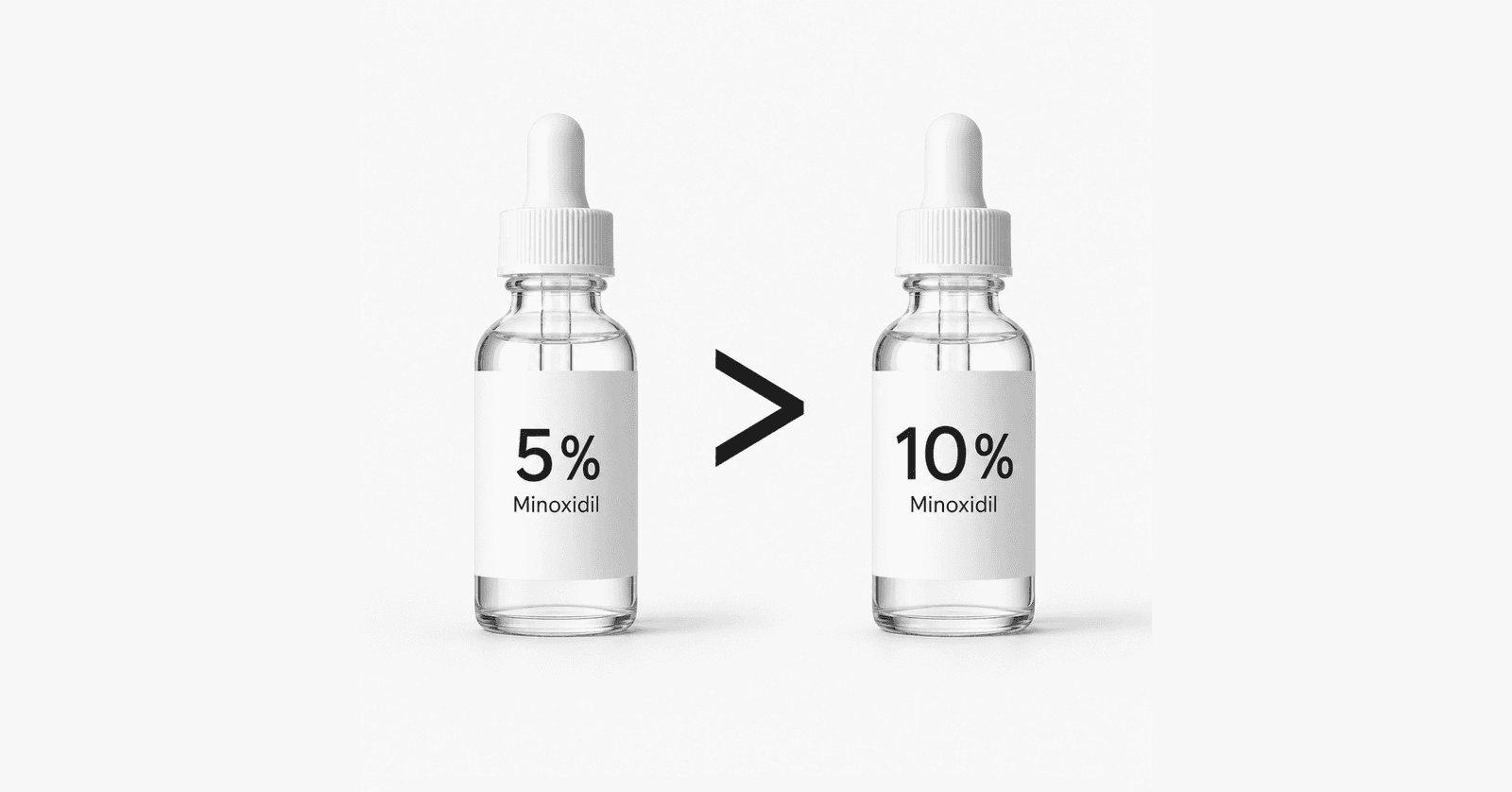
Concentration looks like a real lever, but the only trial to push past 5% found the opposite of what you would expect. 5% topical minoxidil outperformed 2% in a randomized comparison (Olsen 2002). In the one trial to test it, 90 men over 36 weeks, double-blind and placebo-controlled, 5% was significantly better than 10% on both vertex and frontal hair counts, and irritation was marked in the 10% group. The authors describe the result as "opposite to the expected" (Ghonemy 2021). Nobody has tested 6% or 7% against 5%.
That points to two separate ceilings rather than one confirmed mechanism. Frequency stops adding drug above about four applications a day, and that was measured directly. Concentration stopped adding benefit above 5% in a single trial, where the 10% group also had markedly more irritation. Whether the same skin-saturation mechanism explains both is untested. Ghonemy measured hair counts, not absorption, and the worse result at 10% could reflect irritation rather than a shared ceiling.
If the rate-limiting step is diffusion out of a saturated skin reservoir, then no amount of additional product applied to the outside of that reservoir changes the rate. Getting past a skin-imposed ceiling requires a route that does not depend on crossing skin, which is part of why oral minoxidil, prescribed off label and under clinician supervision, behaves so differently for some people. We cover that comparison in our piece on how minoxidil actually works.
Twice-daily dosing is one way to flatten the curve; an oral minoxidil with an extended release profile is the other, and it keeps the regimen at one capsule a day.
What would settle this?
One trial with one extra arm.
Take a single concentration, say 5%, and randomize patients to once daily or twice daily, with hair count as the endpoint. That study has never been run.
Until someone runs it, the honest position is that twice-daily dosing is untested rather than unsupported. Those are different things. The one study to vary frequency found no benefit above four applications a day, but its lower-frequency arm suggested the drug was still getting in below that. Nothing in the pharmacology argues for dropping to once daily, and no published trial title we could find has compared once against twice at a single strength.
Frequently asked questions
Can I apply minoxidil once a day instead of twice?
There is no good evidence for dropping to once daily. The one frequency study found absorption plateaued above four applications a day, but in its lower-frequency arm going from twice to four times daily still increased the amount absorbed (Eller 1989), which suggests the second daily dose is doing something. No trial has compared once against twice at the same strength using hair growth as the endpoint. Discuss any change with your clinician.
Does using more minoxidil make it work faster?
Past about four applications a day, no. Applying four, six or eight times daily produced no increase in systemic absorption in 23 men, where estimated bioavailability fell from 0.55% to 0.42% to 0.27% as frequency rose, leaving the absolute amount absorbed essentially unchanged (Eller 1989), and roughly 41% to 45% of an applied dose was recovered from the scalp surface and pillowcase in another (Franz 1985). No trial has directly tested whether application frequency changes how fast hair responds.
How much minoxidil is absorbed from a topical application?
For a 5% solution, about 1.6% to 1.8% of the applied dose, measured as urinary recovery of radiolabelled drug in 12 men (Franz 1985). A 1 mL application of 5% contains 50 mg, so that works out to roughly 0.8 to 0.9 mg entering the body. Fractional absorption was somewhat higher for a 1% solution.
How long should I leave minoxidil on before washing my hair?
Absorption is about 50% complete within one hour and more than 75% complete by four hours (Ferry 1990). Washing earlier than that reduces how much is taken up, so leaving it on for at least four hours captures most of the available absorption.
Is 10% minoxidil better than 5%?
No. In the only trial to compare them, 90 men over 36 weeks, 5% was significantly better than 10% on both vertex and frontal hair counts, and irritation was marked in the 10% group (Ghonemy 2021). Concentration does matter below that, since 5% outperformed 2% (Olsen 2002), but it appears to stop helping around 5%. Nobody has tested 6% or 7%.
Does applying minoxidil more often cause more side effects?
Systemic accumulation from frequent application is unlikely, because the skin saturates (Eller 1989). Local irritation is a different matter, and applying more product can still irritate the scalp. Irritation is one of the most common reasons people discontinue treatment.
References
- Eller MG, Szpunar GJ, Della-Coletta AA. Absorption of minoxidil after topical application: effect of frequency and site of application. Clin Pharmacol Ther. 1989;45(4):396-402. PMID: 2702797. DOI: 10.1038/clpt.1989.46
- Ferry JJ, Shepard JH, Szpunar GJ. Relationship between contact time of applied dose and percutaneous absorption of minoxidil from a topical solution. J Pharm Sci. 1990;79(6):483-486. PMID: 2395092. DOI: 10.1002/jps.2600790605
- Franz TJ. Percutaneous absorption of minoxidil in man. Arch Dermatol. 1985;121(2):203-206. PMID: 3977334
- Blume-Peytavi U, Hillmann K, Dietz E, Canfield D, Garcia Bartels N. A randomized, single-blind trial of 5% minoxidil foam once daily versus 2% minoxidil solution twice daily in the treatment of androgenetic alopecia in women. J Am Acad Dermatol. 2011;65(6):1126-1134.e2. PMID: 21700360
- Ghonemy S, Alarawi A, Bessar H. Efficacy and safety of a new 10% topical minoxidil versus 5% topical minoxidil and placebo in the treatment of male androgenetic alopecia: a trichoscopic evaluation. J Dermatolog Treat. 2021;32(2):236-241. PMID: 31403367. DOI: 10.1080/09546634.2019.1654070
- Olsen EA, Dunlap FE, Funicella T, et al. A randomized clinical trial of 5% topical minoxidil versus 2% topical minoxidil and placebo in the treatment of androgenetic alopecia in men. J Am Acad Dermatol. 2002;47(3):377-385. PMID: 12196747
This article is for educational purposes only and is not medical advice. Topical minoxidil is FDA approved for androgenetic alopecia and should be used according to its labelling unless a clinician advises otherwise. Nothing here is a recommendation to change a prescribed or labelled dosing regimen. Oral minoxidil is not FDA approved for hair loss and is prescribed off label, a decision to make with a licensed clinician. Talk to your doctor before starting, stopping, or changing any treatment.