How Long Does It Take for Hair Loss Treatments to Work?
Most proven hair-loss treatments show results in 3–6 months and peak by ~12 months. Learn timelines, what to expect each month, and how to track progress.

Most proven hair-loss treatments show results in 3–6 months and peak by ~12 months. Learn timelines, what to expect each month, and how to track progress.

TL;DR
Most proven hair-loss treatments need 3–6 months to show improvement and 6–24 months for peak results. Hair grows in cycles, so even great treatments aren’t instant. Consistency beats intensity, pick a plan you’ll actually follow.

Why It Takes Months: Hair-Cycle 101
Hair follicles rotate through anagen (growth), catagen (transition), and telogen (rest/shedding). Weeks 2–8 of stimulatory therapy can bring a synchronization shed: old club hairs leave as follicles re-enter anagen together. It looks scary but usually signals net positive turnover, clearing room for thicker anagen hair shafts.
In people with androgenetic alopecia (pattern hair loss), dihydrotestosterone (DHT) shortens the anagen phase and gradually miniaturizes follicles.
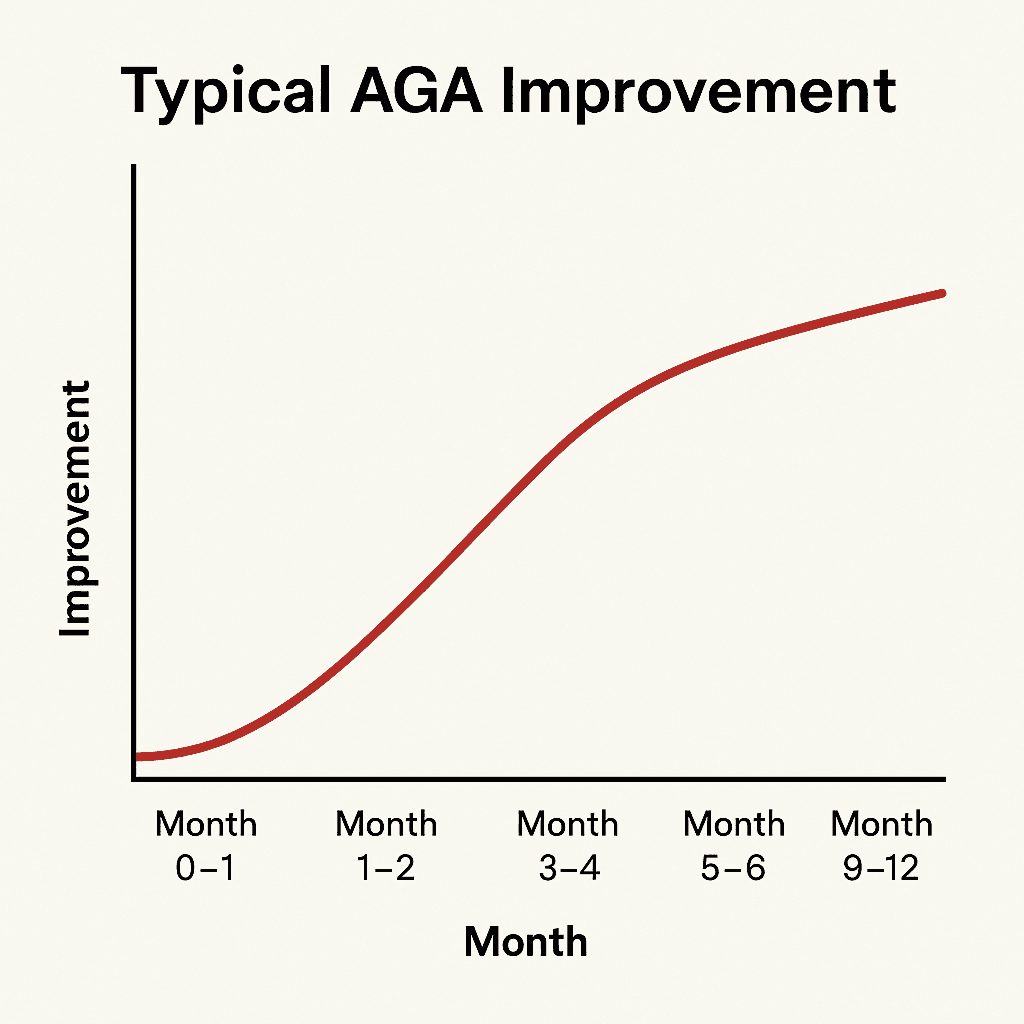
DHT-lowering treatments (e.g., finasteride, dutasteride) don’t “force” growth; they remove the hormonal brake. Over months this lets follicles recover size and normalize their cycle, which is seen clinically as higher anagen:telogen ratios and thicker shafts.
Follicle stimulators (e.g., minoxidil, microneedling) act locally on the follicle (potassium channels, growth-signal pathways). They tend to shorten telogen latency, promote anagen re-entry, and can prolong anagen, leading to increased density.
Quick Timelines by Treatment
Treatment | First sign to look for | Visible improvement | Peak / plateau | Notes |
Less shedding by 6–10 wks | 3–6 mos | 6–12 mos | Upfront shed is common; daily adherence matters. | |
Oral minoxidil (off-label) | 4–8 wks | 3–4 mos | 6–12 mos | Often faster than topical; higher chance of systemic side effects. |
Shedding reduction 1–3 mos | 4–6+ mos | ~12 mos | Most proven DHT-lowering option (men). | |
2–3 mos | 4–6+ mos | ~12 mos | Lower systemic exposure; consistent application required. | |
Dutasteride (off-label US) | 1–2 mos | 3–6 mos | ~12 mos | Stronger DHT suppression; discuss risks. |
Spironolactone (women) | 2–3 mos | 4–6 mos | 6–12 mos | Anti-androgen; avoid in pregnancy. |
Ketoconazole shampoo | Scalp comfort 2–6 wks | 2–4 mos | 4–6 mos | Anti-inflammatory/sebostatic; supportive role. |
Latanoprost (topical) (off-label) | 8–12 wks | 3–6 mos | 6–12 mos | Prostaglandin analog; mixed scalp data; avoid eye contact. |
Thyroid replacement (T4/T3) for true hypothyroidism | 8–12 wks | 3–6 mos | variable | Only when clinically indicated; medical supervision. |
Treating telogen effluvium | Shedding slows 6–8 wks | 3–6 mos | 6–9 mos | Remove trigger; support sleep/nutrition/stress. |
Hair transplant | Grafts shed 0–4 wks | New growth 3–4 mos | 12–18 mos | Final “maturation” ~18 mos; maintenance still needed. |
Microneedling | 6–10 wks | 3–6 mos | 6–12 mos | Weekly/biweekly typical; synergistic with minoxidil. |
Month 0–1
Take baseline photos (same lighting/angle). Start a regimen.
Mild scalp itch/tingle from topicals is common—treat irritation, don’t quit.
Get a trichoscan early on, in month 0-1
Free TrichoScan from Anagen.
Month 1–2
Shedding may rise briefly—expected with stimulators.
DHT-lowering meds begin syncing follicles into growth.
Month 3–4
Shedding stabilizes; baby hairs appear at the hairline/crown.
Early thickening is detectable on trichoscopy or hair-count apps.
Free TrichoScan from Anagen.
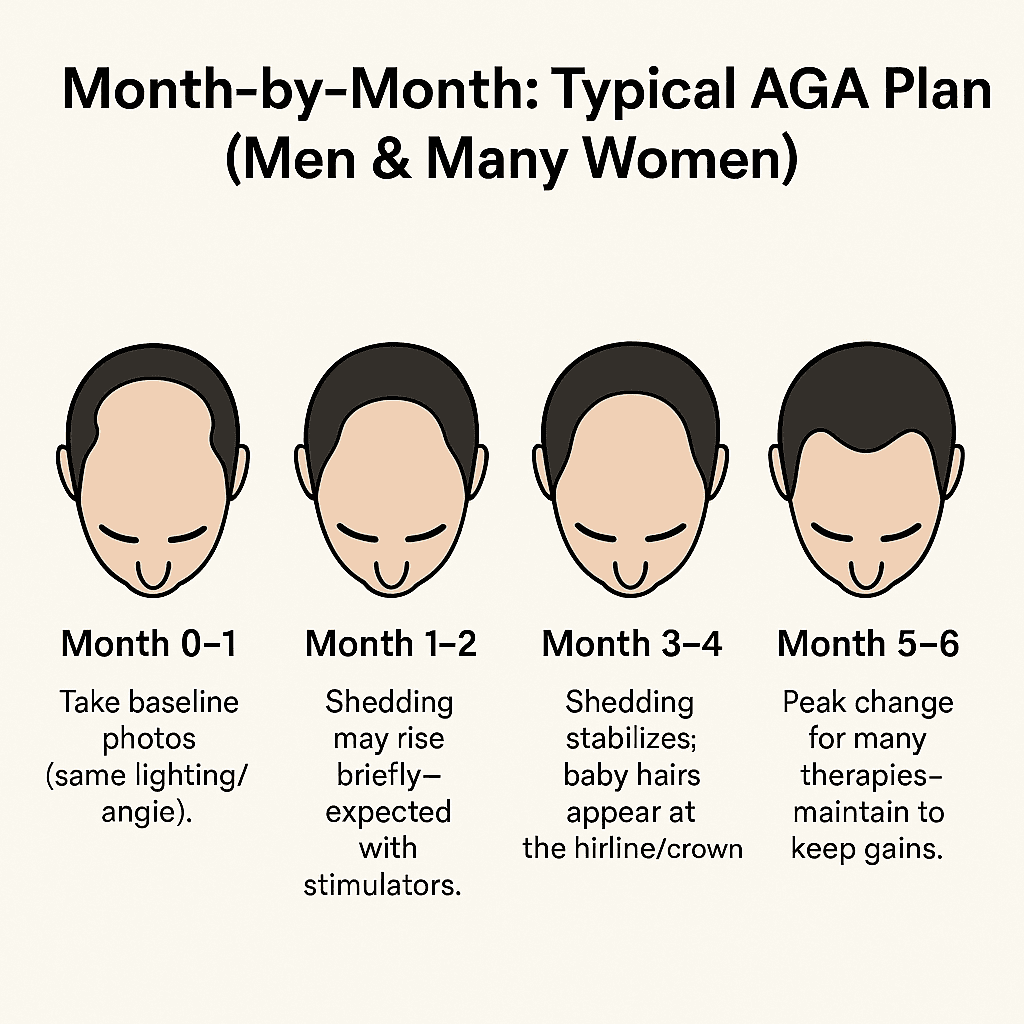
Month 5–6
Visible improvement for responders—narrower part, fuller crown.
If no change with strong adherence, consider targeted tweaks.
Get another trichoscan
Month 9–12
Peak change for many therapies; maintain to keep gains.
Consider microneedling, ketoconazole, or latanoprost for plateaus (clinician-guided)
Get another trichoscan to measure regrowth
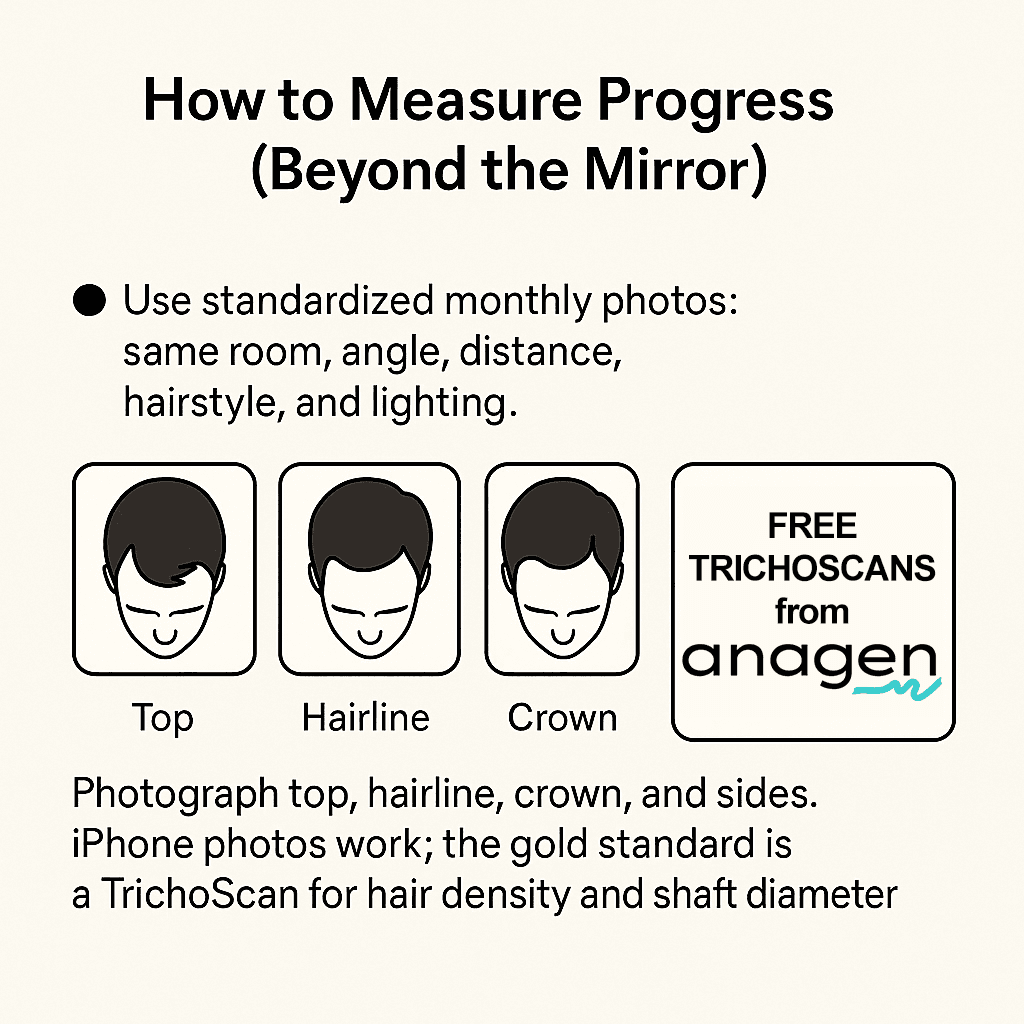
Use standardized monthly photos: same room, angle, distance, hairstyle, and lighting. Photograph top, hairline, crown, and sides. iPhone photos work; the gold standard is a TrichoScan for hair density and shaft diameter. You can get a free Anagen TrichoScan anytime.
Combination Therapy = Better Odds
Stack your plan:
DHT control: Finasteride/Dutasteride (men); Spironolactone for women. (Links to product/clinician pages)
Growth stimulation: Minoxidil ± Microneedling ± Latanoprost/Thyroid (when appropriate).
Scalp health: Ketoconazole; Levocetirizine for itch/inflammation.
Systems check: Iron/ferritin, vitamin D, thyroid, protein intake (clinician-guided).
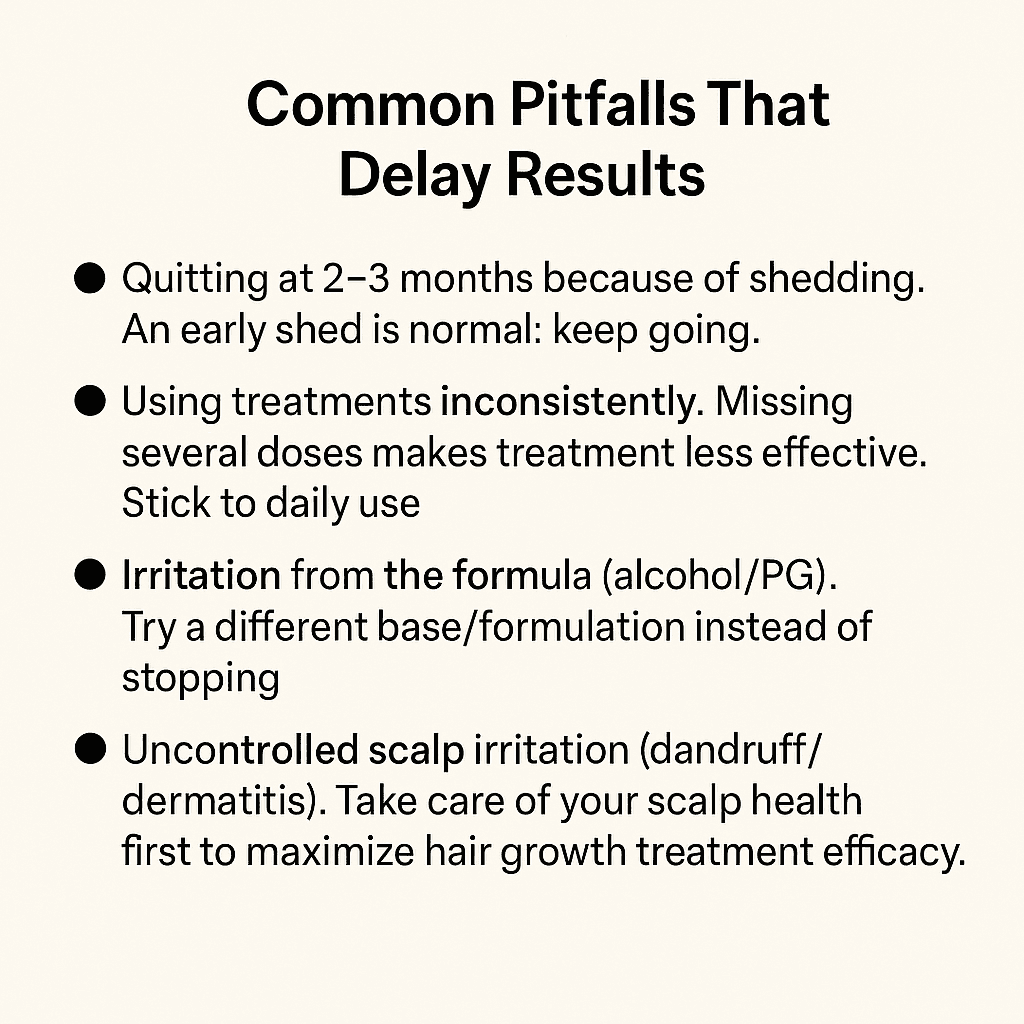
Quitting at 2–3 months because of shedding. An early shed is normal: keep going.
Using treatments inconsistently. Missing several doses makes treatment less effective. Stick to daily use.
Irritation from the formula (alcohol/PG). Try a different base/formulation instead of stopping.
Uncontrolled scalp irritation (dandruff/dermatitis). Take care of your scalp health first to maximize hair growth treatment efficacy.
Ignoring big triggers (crash diets, postpartum, new meds, illness, thyroid issues). Address these with your clinician as they can stall progress.
When to Adjust the Plan
3 months: Tolerating well? Stay the course.
6 months: Minimal change with excellent adherence → consider microneedling, switch topical vehicle, or discuss oral options (off-label where appropriate) with your clinician.
12 months: Plateau → maintain or explore transplant consults. Note: transplants often need maintenance every 4–6 years and still perform best with ongoing oral and topical therapies.
The Bottom Line
Expect meaningful change at 3–6 months and peak around ~12 months.
Consistency > intensity – choose a routine you can sustain.
Combine DHT control + stimulation + scalp health + systemic checkups.
Reassess at 6 and 12 months; adjust thoughtfully, not impulsively.
FAQs
How long before I see results with minoxidil?
Most responders notice improvement by 3–6 months; earlier signs include less shedding by 6–10 weeks.
How long before finasteride works?
Expect reduced shedding at 1–3 months and visible improvement by 4–6+ months, with peak around ~12 months.
How long does it take for a product, like Budget Growth Maxi, Growth Maxi, Mr. Middleground or Guys & Girls to work?
It can take between 3-6 months to see signs of hair regrowth using all Anagen products.
Is early shedding a bad sign?
Usually no, it’s a synchronization shed as follicles re-enter anagen. The weaker hairs are pushed out to make way for thicker ones. In fact, studies suggest that more shedding early on can correlate with stronger regrowth later, since it reflects more follicles resetting their cycle.
What is DHT?
Dihydrotestosterone (DHT) is a hormone made from testosterone that plays important roles in both men and women. During fetal development, it is essential for forming male external genitalia. In the brain, DHT and its metabolites act as neurosteroids that influence mood, cognition, and nerve signaling. In the skin and scalp, excess DHT shortens the growth phase of hair follicles in genetically susceptible people, leading to follicle miniaturization and pattern hair loss.
Do I have to stay on treatments forever?
For AGA, yes. Stopping typically returns you to baseline over months.
What’s the fastest way to improve my odds of regrowing hair?
Combine DHT control (finasteride/dutasteride or spironolactone for women) with follicle stimulation (minoxidil ± microneedling) and scalp health (ketoconazole) while tracking progress with a TrichoScan.
Most proven hair-loss treatments show results in 3–6 months and peak by ~12 months. Learn timelines, what to expect each month, and how to track progress.

TL;DR
Most proven hair-loss treatments need 3–6 months to show improvement and 6–24 months for peak results. Hair grows in cycles, so even great treatments aren’t instant. Consistency beats intensity, pick a plan you’ll actually follow.

Why It Takes Months: Hair-Cycle 101
Hair follicles rotate through anagen (growth), catagen (transition), and telogen (rest/shedding). Weeks 2–8 of stimulatory therapy can bring a synchronization shed: old club hairs leave as follicles re-enter anagen together. It looks scary but usually signals net positive turnover, clearing room for thicker anagen hair shafts.
In people with androgenetic alopecia (pattern hair loss), dihydrotestosterone (DHT) shortens the anagen phase and gradually miniaturizes follicles.

DHT-lowering treatments (e.g., finasteride, dutasteride) don’t “force” growth; they remove the hormonal brake. Over months this lets follicles recover size and normalize their cycle, which is seen clinically as higher anagen:telogen ratios and thicker shafts.
Follicle stimulators (e.g., minoxidil, microneedling) act locally on the follicle (potassium channels, growth-signal pathways). They tend to shorten telogen latency, promote anagen re-entry, and can prolong anagen, leading to increased density.
Quick Timelines by Treatment
Treatment | First sign to look for | Visible improvement | Peak / plateau | Notes |
Less shedding by 6–10 wks | 3–6 mos | 6–12 mos | Upfront shed is common; daily adherence matters. | |
Oral minoxidil (off-label) | 4–8 wks | 3–4 mos | 6–12 mos | Often faster than topical; higher chance of systemic side effects. |
Shedding reduction 1–3 mos | 4–6+ mos | ~12 mos | Most proven DHT-lowering option (men). | |
2–3 mos | 4–6+ mos | ~12 mos | Lower systemic exposure; consistent application required. | |
Dutasteride (off-label US) | 1–2 mos | 3–6 mos | ~12 mos | Stronger DHT suppression; discuss risks. |
Spironolactone (women) | 2–3 mos | 4–6 mos | 6–12 mos | Anti-androgen; avoid in pregnancy. |
Ketoconazole shampoo | Scalp comfort 2–6 wks | 2–4 mos | 4–6 mos | Anti-inflammatory/sebostatic; supportive role. |
Latanoprost (topical) (off-label) | 8–12 wks | 3–6 mos | 6–12 mos | Prostaglandin analog; mixed scalp data; avoid eye contact. |
Thyroid replacement (T4/T3) for true hypothyroidism | 8–12 wks | 3–6 mos | variable | Only when clinically indicated; medical supervision. |
Treating telogen effluvium | Shedding slows 6–8 wks | 3–6 mos | 6–9 mos | Remove trigger; support sleep/nutrition/stress. |
Hair transplant | Grafts shed 0–4 wks | New growth 3–4 mos | 12–18 mos | Final “maturation” ~18 mos; maintenance still needed. |
Microneedling | 6–10 wks | 3–6 mos | 6–12 mos | Weekly/biweekly typical; synergistic with minoxidil. |
Month 0–1
Take baseline photos (same lighting/angle). Start a regimen.
Mild scalp itch/tingle from topicals is common—treat irritation, don’t quit.
Get a trichoscan early on, in month 0-1
Free TrichoScan from Anagen.
Month 1–2
Shedding may rise briefly—expected with stimulators.
DHT-lowering meds begin syncing follicles into growth.
Month 3–4
Shedding stabilizes; baby hairs appear at the hairline/crown.
Early thickening is detectable on trichoscopy or hair-count apps.
Free TrichoScan from Anagen.

Month 5–6
Visible improvement for responders—narrower part, fuller crown.
If no change with strong adherence, consider targeted tweaks.
Get another trichoscan
Month 9–12
Peak change for many therapies; maintain to keep gains.
Consider microneedling, ketoconazole, or latanoprost for plateaus (clinician-guided)
Get another trichoscan to measure regrowth
Use standardized monthly photos: same room, angle, distance, hairstyle, and lighting. Photograph top, hairline, crown, and sides. iPhone photos work; the gold standard is a TrichoScan for hair density and shaft diameter. You can get a free Anagen TrichoScan anytime.

Combination Therapy = Better Odds
Stack your plan:
DHT control: Finasteride/Dutasteride (men); Spironolactone for women. (Links to product/clinician pages)
Growth stimulation: Minoxidil ± Microneedling ± Latanoprost/Thyroid (when appropriate).
Scalp health: Ketoconazole; Levocetirizine for itch/inflammation.
Systems check: Iron/ferritin, vitamin D, thyroid, protein intake (clinician-guided).
Quitting at 2–3 months because of shedding. An early shed is normal: keep going.
Using treatments inconsistently. Missing several doses makes treatment less effective. Stick to daily use.
Irritation from the formula (alcohol/PG). Try a different base/formulation instead of stopping.
Uncontrolled scalp irritation (dandruff/dermatitis). Take care of your scalp health first to maximize hair growth treatment efficacy.
Ignoring big triggers (crash diets, postpartum, new meds, illness, thyroid issues). Address these with your clinician as they can stall progress.

When to Adjust the Plan
3 months: Tolerating well? Stay the course.
6 months: Minimal change with excellent adherence → consider microneedling, switch topical vehicle, or discuss oral options (off-label where appropriate) with your clinician.
12 months: Plateau → maintain or explore transplant consults. Note: transplants often need maintenance every 4–6 years and still perform best with ongoing oral and topical therapies.
The Bottom Line
Expect meaningful change at 3–6 months and peak around ~12 months.
Consistency > intensity – choose a routine you can sustain.
Combine DHT control + stimulation + scalp health + systemic checkups.
Reassess at 6 and 12 months; adjust thoughtfully, not impulsively.
FAQs
How long before I see results with minoxidil?
Most responders notice improvement by 3–6 months; earlier signs include less shedding by 6–10 weeks.
How long before finasteride works?
Expect reduced shedding at 1–3 months and visible improvement by 4–6+ months, with peak around ~12 months.
How long does it take for a product, like Budget Growth Maxi, Growth Maxi, Mr. Middleground or Guys & Girls to work?
It can take between 3-6 months to see signs of hair regrowth using all Anagen products.
Is early shedding a bad sign?
Usually no, it’s a synchronization shed as follicles re-enter anagen. The weaker hairs are pushed out to make way for thicker ones. In fact, studies suggest that more shedding early on can correlate with stronger regrowth later, since it reflects more follicles resetting their cycle.
What is DHT?
Dihydrotestosterone (DHT) is a hormone made from testosterone that plays important roles in both men and women. During fetal development, it is essential for forming male external genitalia. In the brain, DHT and its metabolites act as neurosteroids that influence mood, cognition, and nerve signaling. In the skin and scalp, excess DHT shortens the growth phase of hair follicles in genetically susceptible people, leading to follicle miniaturization and pattern hair loss.
Do I have to stay on treatments forever?
For AGA, yes. Stopping typically returns you to baseline over months.
What’s the fastest way to improve my odds of regrowing hair?
Combine DHT control (finasteride/dutasteride or spironolactone for women) with follicle stimulation (minoxidil ± microneedling) and scalp health (ketoconazole) while tracking progress with a TrichoScan.