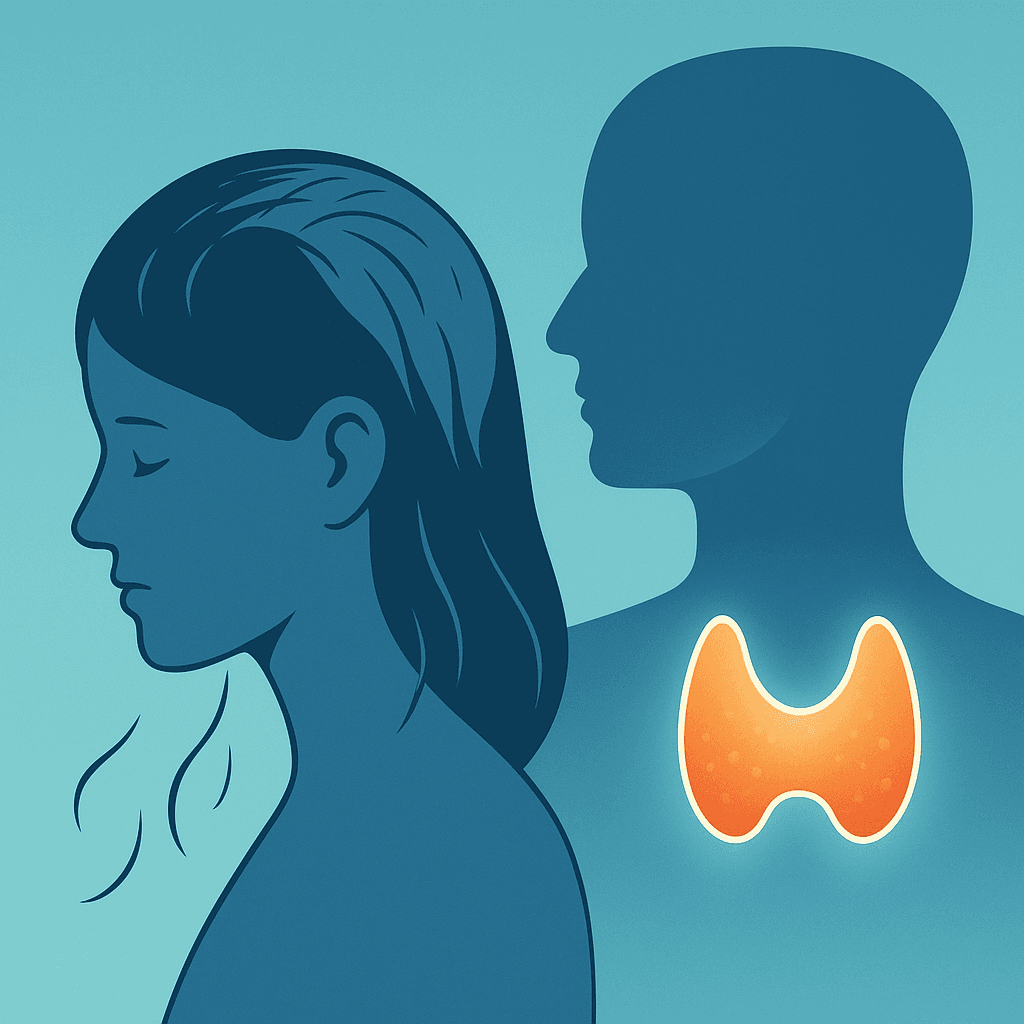
If you're experiencing unexplained hair loss, your thyroid might be the culprit. Thyroid hair loss affects millions of people worldwide, yet it remains one of the most under diagnosed causes of hair thinning. Studies show that up to 50% of individuals with thyroid conditions experience hair loss, making it crucial to understand this often overlooked connection.¹
Hypothyroidism hair loss occurs when your thyroid gland doesn't produce enough hormones to support healthy hair growth. Unlike typical male or female pattern baldness, thyroid related hair loss presents as diffuse thinning across the entire scalp, often accompanied by changes in hair texture and quality.
The relationship between thyroid and hair loss is complex but well established in medical literature. Thyroid hormones, particularly T3 (triiodothyronine), directly regulate hair follicle cycling and are essential for maintaining the anagen (growth) phase of hair development.¹, ² When these hormones are imbalanced, hair follicles enter a prolonged resting phase, leading to increased shedding and reduced regrowth.
What is Thyroid Related Hair Loss?
Thyroid related hair loss is a form of diffuse alopecia caused by thyroid hormone imbalances. Unlike androgenetic alopecia (male/female pattern baldness), which typically affects specific areas like the crown or temples, thyroid hair loss causes uniform thinning across the entire scalp.
The thyroid gland produces two primary hormones: T4 (thyroxine) and T3 (triiodothyronine). T3 hair loss specifically occurs when active T3 levels are insufficient to support normal hair follicle function. T3 is the more potent hormone and directly influences cellular metabolism in hair follicles.³
Thyroid hormone hair growth regulation occurs through several mechanisms:
- Controlling the duration of the anagen (growth) phase
- Regulating keratinocyte proliferation in hair follicles
- Influencing hair shaft diameter and strength
- Modulating hair pigmentation
Research indicates that hair follicles contain thyroid hormone receptors, making them direct targets for thyroid hormone action.², ⁴ When thyroid function is compromised, these follicles cannot maintain their normal growth cycles.
Causes of Thyroid Hair Loss
Primary Thyroid Disorders
Hypothyroidism is the most common cause of thyroid related hair loss. This condition occurs when the thyroid gland produces insufficient hormones, affecting approximately 4.6% of the U.S. population.⁵ Low thyroid hair loss typically develops gradually as hormone levels decline.
Hashimoto's thyroiditis, an autoimmune condition, accounts for 90% of hypothyroidism cases in developed countries.⁶ The autoimmune attack on thyroid tissue leads to progressive hormone deficiency and subsequent hair loss.
Hyperthyroidism can also cause hair loss, though through different mechanisms. Excess thyroid hormones accelerate hair follicle cycling, leading to premature entry into the telogen (resting) phase.
Secondary Factors
Thyroid medication hair loss can occur as a side effect of treatment. Some patients experience temporary hair shedding when starting thyroid hormone replacement therapy, as the body adjusts to normalized hormone levels.
Nutritional deficiencies commonly associated with thyroid dysfunction include:
- Iron deficiency (affects 25% of hypothyroid patients)⁷
- Selenium deficiency (impairs T4 to T3 conversion)
- Zinc deficiency (essential for thyroid hormone synthesis)
Symptoms and Diagnosis
Recognizing Thyroid Hair Loss
Thyroid related hair loss has distinct characteristics that differentiate it from other types of alopecia:
Hair Loss Pattern:
- Diffuse thinning across the entire scalp
- No specific pattern (unlike male/female pattern baldness)
- Gradual onset over months to years
- May affect body hair as well
Hair Quality Changes:
- Hair becomes dry, coarse, and brittle
- Loss of natural shine and luster
- Increased breakage and split ends
- Changes in hair color or texture
Associated Symptoms: Thyroid hair loss rarely occurs in isolation. Common accompanying symptoms include:
- Fatigue and weakness
- Weight gain or difficulty losing weight
- Cold intolerance
- Dry skin
- Constipation
- Depression or mood changes
- Irregular menstrual periods
Diagnostic Testing
Proper diagnosis requires comprehensive thyroid testing beyond the standard TSH (thyroid stimulating hormone) test. Essential tests include:
Complete Thyroid Panel:
- TSH (normal range: 0.4-4.0 mIU/L, optimal for hair: 1.0-2.0 mIU/L)
- Free T4 (thyroxine)
- Free T3 (triiodothyronine)
- Reverse T3 (inactive form that can block T3 action)
- Thyroid antibodies (TPO and TgAb)
Research suggests that hair loss can occur even with "normal" TSH levels if T3 is low or reverse T3 is elevated.⁸ Many patients with hair loss have subclinical hypothyroidism, where TSH is elevated but still within the reference range.
Treatment Options for Thyroid Hair Loss
Conventional Thyroid Treatment
Topical Thyroid Hormone Therapy: Recent research has explored topical application of T3 directly to the scalp. Studies show that topical T3 can stimulate hair follicle activity and promote regrowth in thyroid related hair loss cases. A recent study showed an average regrowth of 42.5 hairs per cm2 in six month which is about double the regrowth on Minoxidil. We now offer a low dose topical thyroid hormone for hair loss.
Combination Therapy: Optimal thyroid hair loss treatment often requires addressing multiple factors:
- Thyroid hormone optimization
- Nutritional deficiency correction
- Anti inflammatory support
- Stress management
Is Thyroid Hair Loss Reversible?
Thyroid hair loss reversible outcomes depend on several factors:
Positive Prognostic Factors:
- Early detection and treatment
- Adequate thyroid hormone replacement
- Correction of nutritional deficiencies
- Absence of other hair loss causes
Timeline for Recovery:
- Initial response: 3-4 months after optimal treatment
- Significant improvement: 6-12 months
- Maximum recovery: 12-18 months
Studies indicate that 70-80% of patients experience significant hair regrowth with proper thyroid treatment, though complete recovery may take up to two years.
Lifestyle and Nutritional Support
Essential Nutrients for Thyroid and Hair Health
Iron: Iron deficiency is present in 40% of women with hair loss and is particularly common in hypothyroid patients.¹³ Optimal ferritin levels (50-150 ng/mL) are essential for both thyroid function and hair growth.
Selenium: This mineral is crucial for T4 to T3 conversion. Selenium deficiency can worsen thyroid hair loss even with adequate hormone replacement.¹⁴
Zinc: Zinc plays a vital role in thyroid hormone synthesis and hair follicle health. Deficiency can contribute to both thyroid dysfunction and hair loss.¹⁵
Stress Management
Chronic stress elevates cortisol levels, which can suppress thyroid function and worsen hair loss. Stress management techniques including meditation, yoga, and adequate sleep are important components of treatment.
When to Seek Professional Help
Consult a healthcare provider if you experience:
- Rapid or extensive hair loss
- Hair loss accompanied by thyroid symptoms
- No improvement after 6 months of thyroid treatment
- Worsening hair loss despite treatment
Early intervention is crucial for optimal outcomes in thyroid related hair loss.
In Conclusion
Understanding the connection between thyroid function and hair health is essential for anyone experiencing unexplained hair loss. While thyroid hair loss can be distressing, it's often reversible with proper diagnosis and treatment. The key is comprehensive evaluation beyond standard thyroid tests and addressing all contributing factors.
Modern treatment approaches, including topical thyroid hormone therapy, offer new hope for patients who haven't responded to conventional treatments. With proper care, most people with thyroid related hair loss can expect significant improvement and often complete recovery of their hair.
References:
- Dawber RP, Simpson NB, Barth JH. Diseases of the Hair and Scalp. Oxford, UK: Blackwell Science; 1997. Diffuse alopecia: Endocrine, metabolic and chemical influences on the follicular cycle ; pp. 123–150
- Billoni N, et al. Thyroid hormone receptor beta1 is expressed in the human hair follicle. Br J Dermatol. 2000;142(4):645-652.
- van Beek N, et al. Thyroid hormones directly alter human hair follicle functions: anagen prolongation and stimulation of both hair matrix keratinocyte proliferation and hair pigmentation. J Clin Endocrinol Metab. 2008;93(11):4381-4388.
- Slominski A, et al. Thyroid hormones and the skin: known effects and new concepts. Exp Dermatol. 2017;26(7):618-625.
- Chaker L, et al. Hypothyroidism. Lancet. 2017;390(10101):1550-1562.
- Ralli M, et al. Hashimoto's thyroiditis: An update on pathogenic mechanisms, diagnostic protocols, therapeutic strategies, and potential malignant transformation. Autoimmun Rev. 2020;19(10):102649.
- Beard JL, et al. Iron biology in immune function, muscle metabolism and neuronal functioning. J Nutr. 2001;131(2S-2):568S-579S.
- Hoermann R, et al. Homeostatic control of the thyroid-pituitary axis: perspectives for diagnosis and treatment. Front Endocrinol. 2015;6:177.
- Okosieme O, et al. Primary thyroid failure in adult life. BMJ. 2018;360:k2394.
- Jonklaas J, et al. Guidelines for the treatment of hypothyroidism: prepared by the american thyroid association task force on thyroid hormone replacement. Thyroid. 2014;24(12):1670-1751.
- Langan EA, et al. Topical thyroid hormone accelerates and enhances the wound healing process. J Invest Dermatol. 2014;134(7):1959-1968.
- Cotsarelis G. Epithelial stem cells: a folliculocentric view. J Invest Dermatol. 2006;126(7):1459-1468.
- Trost LB, et al. The diagnosis and treatment of iron deficiency and its potential relationship to hair loss. J Am Acad Dermatol. 2006;54(5):824-844.
- Duntas LH. Selenium and the thyroid: a close-knit connection. J Clin Endocrinol Metab. 2010;95(12):5180-5188.
- Kil MS, et al. Analysis of serum zinc and copper concentrations in hair loss. Ann Dermatol. 2013;25(4):405-409.