Finasteride vs Minoxidil: Which Is Right for You?
Finasteride vs Minoxidil—discover which FDA-approved hair loss treatment is right for you. Learn how each works, who can use them, and the safest, most effective doses for men and women.

Finasteride vs Minoxidil—discover which FDA-approved hair loss treatment is right for you. Learn how each works, who can use them, and the safest, most effective doses for men and women.

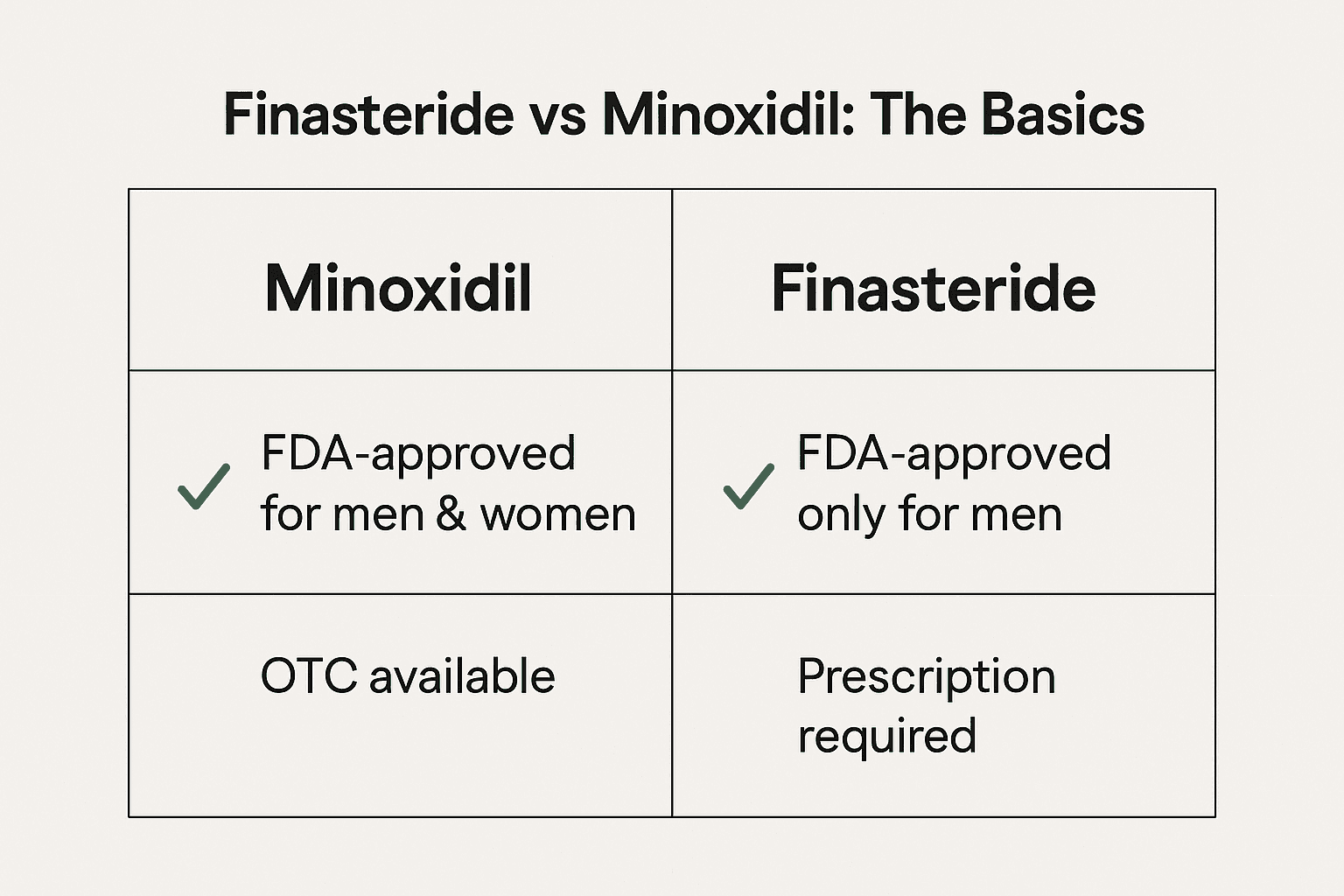
When it comes to FDA-approved treatments for hair loss, only two drugs are officially recognized: oral Finasteride and topical Minoxidil. Both are effective, but they work in very different ways. Finasteride is FDA-approved only for men, while Minoxidil is approved for both men and women. They can also be combined in men for even greater regrowth. Here’s how they compare, and how to decide which option (or combination) makes sense for you.
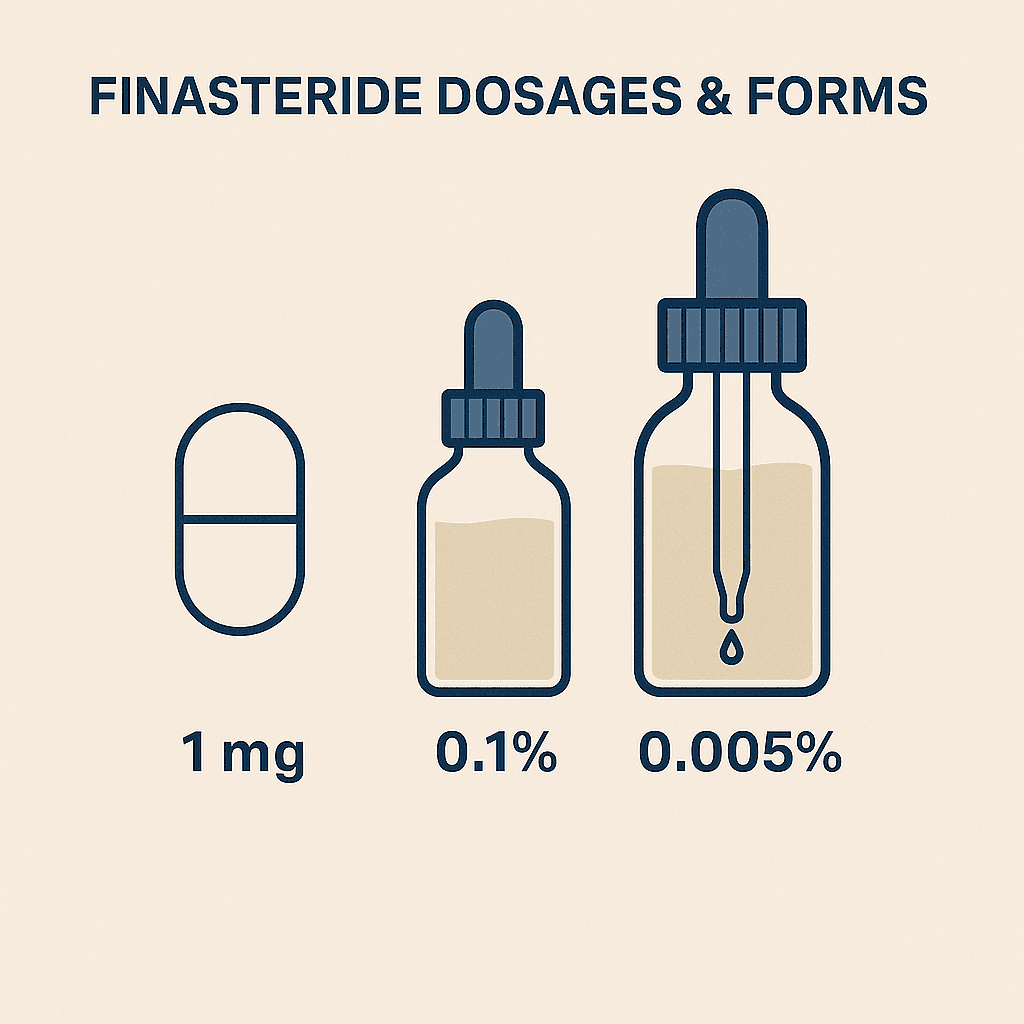
Finasteride: FDA-approved only for men in its oral form (1 mg daily by prescription). Topical finasteride is prescribed off-label, with concentrations ranging from very low-dose formulas such as 0.005% (for example, Anagen.xyz offers this strength to help limit systemic side effects) up to more common ranges like 0.1% to 0.25%, and sometimes higher depending on the clinic.
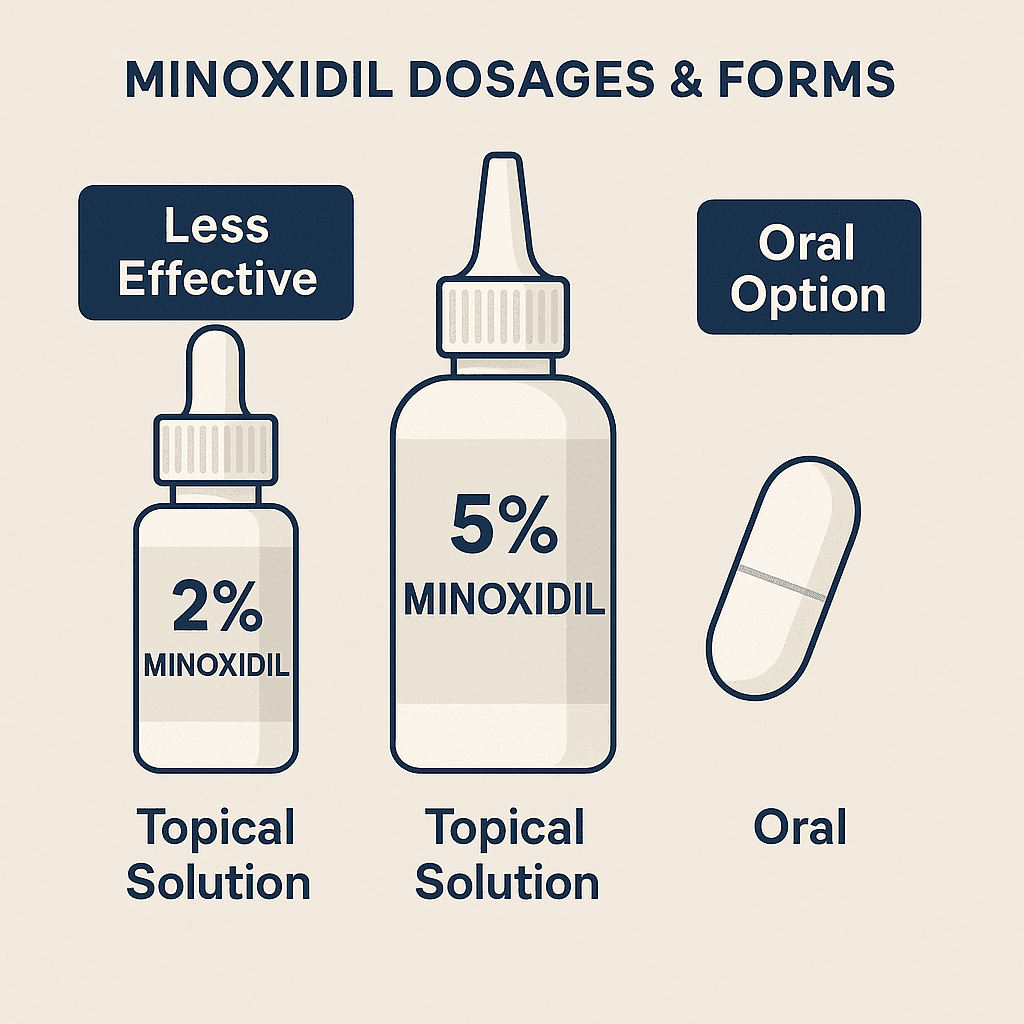
Minoxidil: FDA-approved for both men and women. Available over the counter in topical form (2% and 5%) and sometimes prescribed in oral form, although oral use is off-label.
Both drugs can help regrow hair, but they work through very different mechanisms. That is why they can be highly synergistic when used together.

Originally developed as a blood pressure medication, Minoxidil was later found to stimulate hair growth. Its exact mechanism of action is not fully understood, but research suggests it may:
Open ATP-sensitive potassium channels in follicle cells
Activate pro-growth pathways such as VEGF and Wnt signaling
Influence prostaglandins that regulate the hair cycle
Protect follicle cells from oxidative stress by reducing calcium overload in mitochondria
Create a more favorable environment for growth by lowering certain inflammatory signals
Extend the hair growth (anagen) phase
Dosages and Forms
2% vs 5% topical Minoxidil: Both outperform placebo, but 5% is consistently more effective for men and women
Topical vs oral: Topical is the safer first step. Oral Minoxidil is prescribed off-label at low doses for patients who do not respond to, or cannot tolerate, topical use

Side Effects
Topical Minoxidil: Most common are scalp irritation, dryness, or itching. Rarely, unwanted body or facial hair growth (hypertrichosis)
Oral Minoxidil (low-dose, off-label): Can carry more serious risks, including fluid retention, swelling of the ankles/eyelids, dizziness, changes in blood pressure, rapid heart rate, and in rare cases, pericardial effusion or arrhythmias
Most side effects are reversible once treatment is stopped
Originally developed to treat benign prostatic hyperplasia (BPH), Finasteride also proved effective for androgenetic alopecia (male pattern hair loss). It works by:
Inhibiting 5-α-reductase type II, the enzyme that converts testosterone into dihydrotestosterone (DHT).
Lowering scalp DHT levels, which not only slows follicle miniaturization but can also reverse it to a degree, allowing weakened follicles to thicken and produce more visible hair again.
Triggering a downstream cascade of effects that prolong follicle survival, increase time in the growth (anagen) phase, and improve hair density in men with pattern hair loss.
Dosages and Forms
Oral Finasteride 1 mg daily is the FDA-approved standard prescription for men.
Topical Finasteride 0.1% is prescribed off-label and may offer similar efficacy with potentially fewer systemic side effects.
Lower topical doses (e.g. 0.005%) are sometimes used by clinics and companies (such as Anagen.xyz) to help reduce systemic exposure while maintaining efficacy.

Side Effects
Only approved for men, as exposure during pregnancy can cause serious fetal harm.
Possible sexual side effects in men, including reduced libido, erectile dysfunction, decreased sperm count, or changes in sperm motility. Rarely, mood changes such as anxiety or depression have been reported.
Risk is dose-dependent: lower doses, particularly in topical formulations, minimize systemic absorption and may reduce side effect risk.
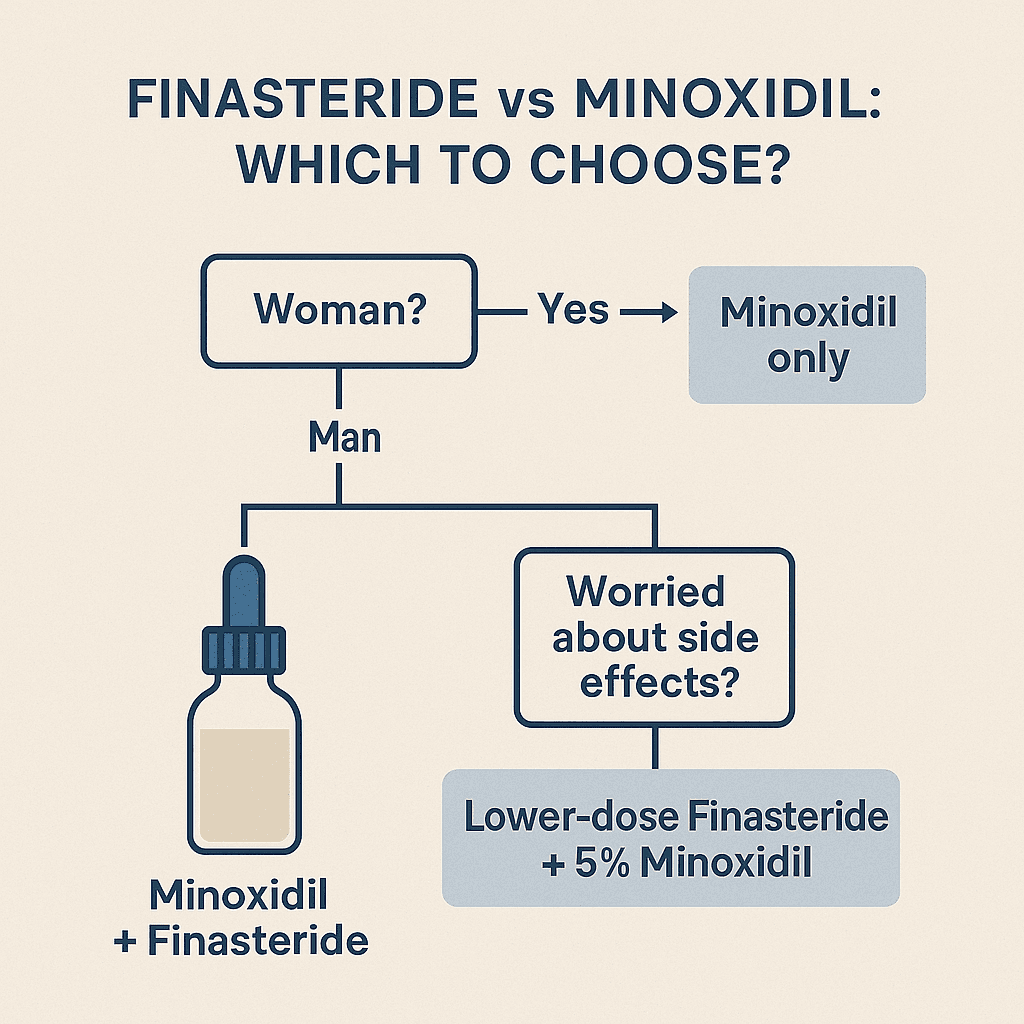
For Women:
Minoxidil is the only FDA-approved treatment. Finasteride is unsafe for women who are or may become pregnant.
Your choice depends on regrowth goals and risk tolerance.
Oral Minoxidil (low dose, off-label) tends to give the strongest regrowth, but comes with a higher risk of systemic side effects (blood pressure changes, swelling, unwanted body hair).
5% topical Minoxidil is the next most effective, and is generally well tolerated.
2% topical Minoxidil is less effective but carries the lowest side effect risk.
For Men:
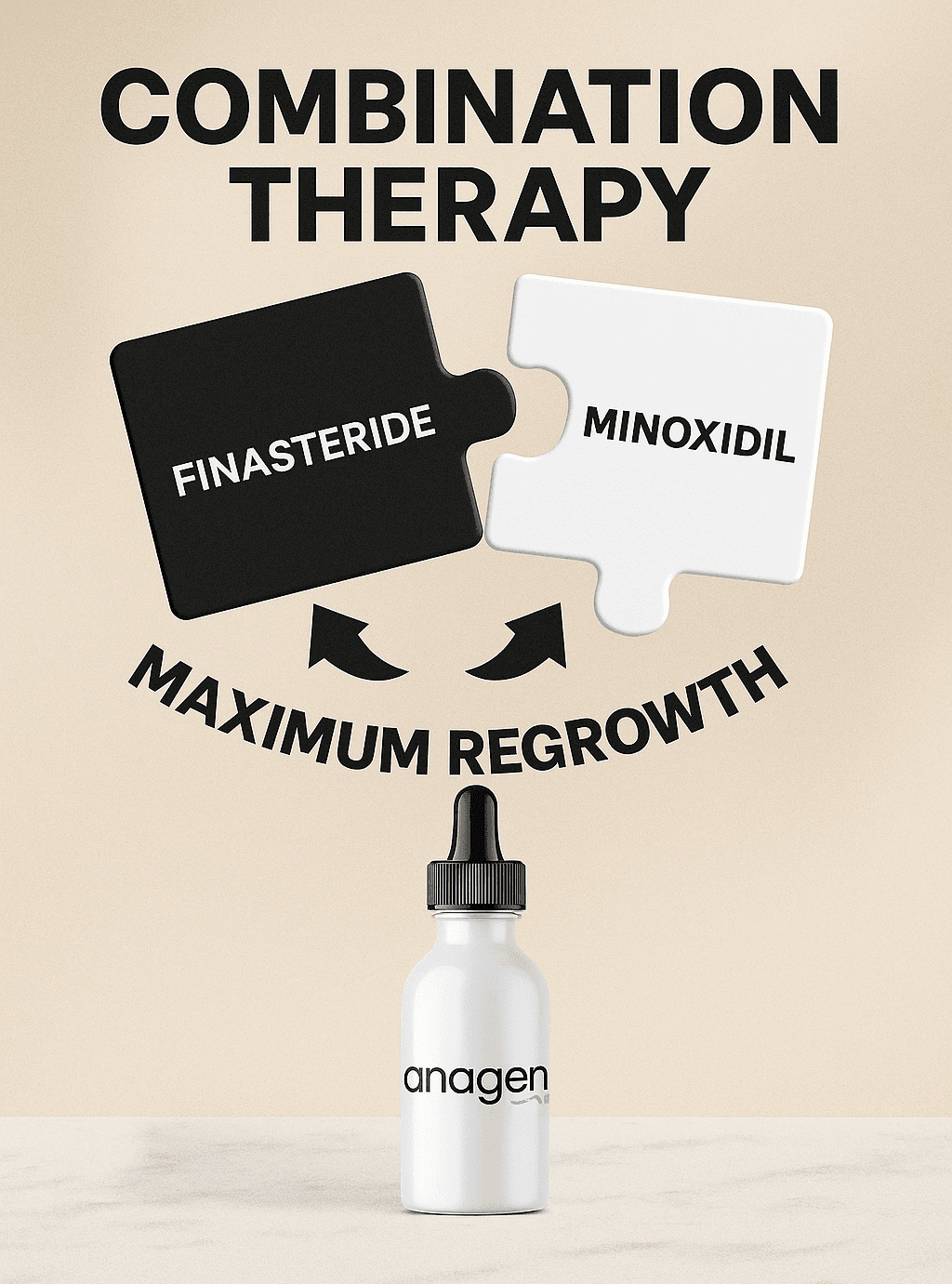
The best results usually come from combining Finasteride and Minoxidil since they target different pathways.
Oral Finasteride (1 mg daily) is the gold standard for blocking DHT and preventing further loss.
Topical Finasteride (0.005–0.1%) is an option for those concerned about systemic side effects.
Oral Minoxidil (low dose, off-label) is used in resistant cases or when topical isn’t tolerated.
Topical Minoxidil (5%) is the standard follicle stimulator and pairs well with Finasteride.
Combination Approach:
High-efficacy combo: Oral Finasteride + 5% Topical Minoxidil
Lower-side-effect combo: Topical Finasteride (0.005–0.1%) + 5% Topical Minoxidil
For resistant cases, some doctors prescribe Oral Finasteride + Oral Minoxidil, though this requires closer monitoring.
Where to Get Them:
Both treatments are available through anagen.xyz. With options like Budget Growth Maxi and Growth Maxi, you can access combination formulas that bring together the strongest science-backed ingredients for maximum regrowth.

Is Finasteride or Minoxidil more effective for hair loss?
Clinical trials show Finasteride typically regrows more hairs per cm² than Minoxidil. After 6 months, Finasteride increased hair counts by about 15–20 hairs/cm², compared with 8–12 hairs/cm² for 5% Minoxidil. Since they work by different mechanisms, the combination is usually most effective for men.
Can women take Finasteride for hair loss?
No. Finasteride is FDA-approved only for men and can cause serious risks in pregnancy. Women should use Minoxidil or discuss off-label options with a doctor.
What’s the best Minoxidil strength: 2% or 5%?
5% Minoxidil is more effective for both men and women, though 2% can still help and may have fewer side effects.
Is oral Minoxidil safe? - Low-dose oral Minoxidil is increasingly prescribed, but it carries higher risks of systemic side effects than topical. Always try using topical treatments first unless directed otherwise by your doctor.
Does topical Finasteride work as well as oral?
Topical Finasteride (0.1%) can deliver similar results with less potential for systemic effects, though absorption still occurs. 0.005% topical finasteride can be a good option for men worried about side effects.
Can Finasteride and Minoxidil be used together?
Yes but for men only. Using both maximizes results by addressing different causes of hair loss – DHT suppression (Finasteride) plus follicle stimulation (Minoxidil).
Are compounded Minoxidil & Finasteride treatments available?
Yes, Anagen has many compounded products which include both minoxidil and finasteride such as Growth Maxi, The Basics, and Mr. Middleground.
Finasteride vs Minoxidil—discover which FDA-approved hair loss treatment is right for you. Learn how each works, who can use them, and the safest, most effective doses for men and women.

When it comes to FDA-approved treatments for hair loss, only two drugs are officially recognized: oral Finasteride and topical Minoxidil. Both are effective, but they work in very different ways. Finasteride is FDA-approved only for men, while Minoxidil is approved for both men and women. They can also be combined in men for even greater regrowth. Here’s how they compare, and how to decide which option (or combination) makes sense for you.
Finasteride: FDA-approved only for men in its oral form (1 mg daily by prescription). Topical finasteride is prescribed off-label, with concentrations ranging from very low-dose formulas such as 0.005% (for example, Anagen.xyz offers this strength to help limit systemic side effects) up to more common ranges like 0.1% to 0.25%, and sometimes higher depending on the clinic.
Minoxidil: FDA-approved for both men and women. Available over the counter in topical form (2% and 5%) and sometimes prescribed in oral form, although oral use is off-label.
Both drugs can help regrow hair, but they work through very different mechanisms. That is why they can be highly synergistic when used together.

Originally developed as a blood pressure medication, Minoxidil was later found to stimulate hair growth. Its exact mechanism of action is not fully understood, but research suggests it may:
Open ATP-sensitive potassium channels in follicle cells
Activate pro-growth pathways such as VEGF and Wnt signaling
Influence prostaglandins that regulate the hair cycle
Protect follicle cells from oxidative stress by reducing calcium overload in mitochondria
Create a more favorable environment for growth by lowering certain inflammatory signals
Extend the hair growth (anagen) phase
Dosages and Forms
2% vs 5% topical Minoxidil: Both outperform placebo, but 5% is consistently more effective for men and women
Topical vs oral: Topical is the safer first step. Oral Minoxidil is prescribed off-label at low doses for patients who do not respond to, or cannot tolerate, topical use

Side Effects
Topical Minoxidil: Most common are scalp irritation, dryness, or itching. Rarely, unwanted body or facial hair growth (hypertrichosis)
Oral Minoxidil (low-dose, off-label): Can carry more serious risks, including fluid retention, swelling of the ankles/eyelids, dizziness, changes in blood pressure, rapid heart rate, and in rare cases, pericardial effusion or arrhythmias
Most side effects are reversible once treatment is stopped
Originally developed to treat benign prostatic hyperplasia (BPH), Finasteride also proved effective for androgenetic alopecia (male pattern hair loss). It works by:
Inhibiting 5-α-reductase type II, the enzyme that converts testosterone into dihydrotestosterone (DHT).
Lowering scalp DHT levels, which not only slows follicle miniaturization but can also reverse it to a degree, allowing weakened follicles to thicken and produce more visible hair again.
Triggering a downstream cascade of effects that prolong follicle survival, increase time in the growth (anagen) phase, and improve hair density in men with pattern hair loss.
Dosages and Forms
Oral Finasteride 1 mg daily is the FDA-approved standard prescription for men.
Topical Finasteride 0.1% is prescribed off-label and may offer similar efficacy with potentially fewer systemic side effects.
Lower topical doses (e.g. 0.005%) are sometimes used by clinics and companies (such as Anagen.xyz) to help reduce systemic exposure while maintaining efficacy.

Side Effects
Only approved for men, as exposure during pregnancy can cause serious fetal harm.
Possible sexual side effects in men, including reduced libido, erectile dysfunction, decreased sperm count, or changes in sperm motility. Rarely, mood changes such as anxiety or depression have been reported.
Risk is dose-dependent: lower doses, particularly in topical formulations, minimize systemic absorption and may reduce side effect risk.
For Women:
Minoxidil is the only FDA-approved treatment. Finasteride is unsafe for women who are or may become pregnant.
Your choice depends on regrowth goals and risk tolerance.
Oral Minoxidil (low dose, off-label) tends to give the strongest regrowth, but comes with a higher risk of systemic side effects (blood pressure changes, swelling, unwanted body hair).
5% topical Minoxidil is the next most effective, and is generally well tolerated.
2% topical Minoxidil is less effective but carries the lowest side effect risk.
For Men:
The best results usually come from combining Finasteride and Minoxidil since they target different pathways.
Oral Finasteride (1 mg daily) is the gold standard for blocking DHT and preventing further loss.
Topical Finasteride (0.005–0.1%) is an option for those concerned about systemic side effects.
Oral Minoxidil (low dose, off-label) is used in resistant cases or when topical isn’t tolerated.
Topical Minoxidil (5%) is the standard follicle stimulator and pairs well with Finasteride.
Combination Approach:
High-efficacy combo: Oral Finasteride + 5% Topical Minoxidil
Lower-side-effect combo: Topical Finasteride (0.005–0.1%) + 5% Topical Minoxidil
For resistant cases, some doctors prescribe Oral Finasteride + Oral Minoxidil, though this requires closer monitoring.
Where to Get Them:
Both treatments are available through anagen.xyz. With options like Budget Growth Maxi and Growth Maxi, you can access combination formulas that bring together the strongest science-backed ingredients for maximum regrowth.

Is Finasteride or Minoxidil more effective for hair loss?
Clinical trials show Finasteride typically regrows more hairs per cm² than Minoxidil. After 6 months, Finasteride increased hair counts by about 15–20 hairs/cm², compared with 8–12 hairs/cm² for 5% Minoxidil. Since they work by different mechanisms, the combination is usually most effective for men.
Can women take Finasteride for hair loss?
No. Finasteride is FDA-approved only for men and can cause serious risks in pregnancy. Women should use Minoxidil or discuss off-label options with a doctor.
What’s the best Minoxidil strength: 2% or 5%?
5% Minoxidil is more effective for both men and women, though 2% can still help and may have fewer side effects.
Is oral Minoxidil safe? - Low-dose oral Minoxidil is increasingly prescribed, but it carries higher risks of systemic side effects than topical. Always try using topical treatments first unless directed otherwise by your doctor.
Does topical Finasteride work as well as oral?
Topical Finasteride (0.1%) can deliver similar results with less potential for systemic effects, though absorption still occurs. 0.005% topical finasteride can be a good option for men worried about side effects.
Can Finasteride and Minoxidil be used together?
Yes but for men only. Using both maximizes results by addressing different causes of hair loss – DHT suppression (Finasteride) plus follicle stimulation (Minoxidil).
Are compounded Minoxidil & Finasteride treatments available?
Yes, Anagen has many compounded products which include both minoxidil and finasteride such as Growth Maxi, The Basics, and Mr. Middleground.