What DHT Actually Does Downstream, and Why Targeting Below the Hormone Matters
DHT does not shrink a follicle by touching the hair. It flips a switch inside dermal papilla cells, which then release inhibitory signals like DKK-1, TGF-beta, and IL-6.
DHT does not shrink a follicle by touching the hair. It flips a switch inside dermal papilla cells, which then release inhibitory signals like DKK-1, TGF-beta, and IL-6.
Almost every explanation of male-pattern hair loss stops at "DHT shrinks the follicle." That skips the part that actually matters, and the part that tells you where a treatment could act.
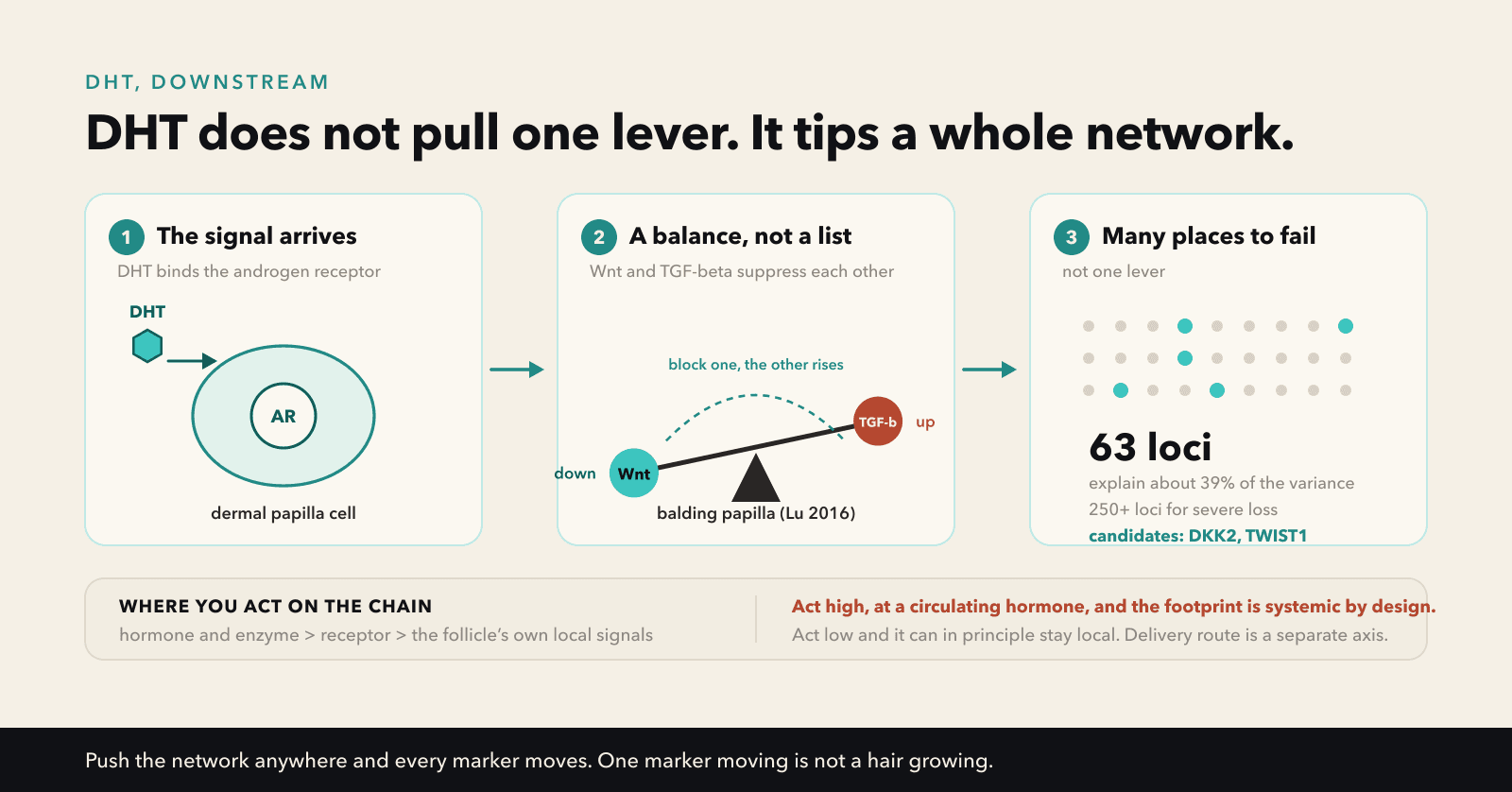
Short answer: DHT does not attack the hair shaft directly. It enters dermal papilla cells at the base of a genetically susceptible follicle, binds the androgen receptor, and changes which genes those cells switch on. The reprogrammed papilla then secretes inhibitory paracrine signals, including DKK-1, TGF-beta, and IL-6 in laboratory models, that tell the surrounding hair-making cells to slow down, retract, and eventually produce a thinner hair. Two things complicate the usual telling. Those signals are not independent: Wnt and TGF-beta suppress each other reciprocally, so the papilla behaves like a balance that DHT tips rather than a queue of separate events. And the system is highly polygenic, with 63 loci explaining roughly 39% of the variance in male-pattern baldness, so DHT is tipping a network with many places to fail rather than pulling one lever. Because this is a web and not a single event, there is a genuine strategic question in where along it you try to intervene, and a matching reason to distrust any result that rests on a single marker moving. This article is educational and is not a description of any Anagen product.
Dihydrotestosterone (DHT) is an androgen, a male-type sex hormone. It is made from testosterone by an enzyme called 5-alpha-reductase, which exists in two main forms in the body. DHT binds the androgen receptor more tightly than testosterone does, which makes it the more potent androgen at the level of the receptor.
In androgenetic alopecia, the common patterned hair loss in men and women, DHT is the hormone most strongly associated with the miniaturization of scalp follicles. But the word "associated" is doing important work in that sentence. DHT circulates through the whole body and bathes every follicle you have. Yet in the same person it can thicken a beard and thin a scalp. The hormone is the same everywhere. What differs is how a particular follicle is wired to respond. That single observation is the key to everything that follows: the interesting biology is not really the hormone. It is what the follicle does with it.
Not on the hair. This is the part most people get backwards.
The hair shaft itself is dead, keratinized material. The living, dividing cells that build a hair sit in the bulb at the base of the follicle, and they are directed by a small cluster of specialized cells called the dermal papilla. Think of the dermal papilla as the follicle's control room. It does not make the hair itself. It instructs the surrounding matrix cells that do.
Decades of laboratory work point to the dermal papilla, not the hair-making cells, as the primary androgen target in the follicle. Dermal papilla cells carry the androgen receptor, and cultured papilla cells respond to androgen by changing what they release into their surroundings (Itami et al 1995; Inui and Itami 2011). So DHT does not shrink a hair by grabbing the hair. It gives an order to the control room, and the control room passes the consequences on.
Here is the core of the downstream chain, laid out step by step:
Step 1. DHT diffuses into a susceptible dermal papilla cell. Step 2. Inside the cell, DHT binds the androgen receptor. The bound receptor moves into the nucleus and acts as a switch that turns certain genes up and others down. Step 3. With its gene expression rewritten, the papilla cell changes its secretions, the paracrine signals it releases to the cells around it. Step 4. Those secreted signals reach the neighboring hair-making matrix cells and the follicle's own stem-cell compartment, and they carry a suppressive message. Step 5. Over repeated hair cycles, that suppressive message shortens the growth phase and shrinks the follicle, so each new hair is thinner and shorter than the last. This is miniaturization.
The critical conceptual move is Step 3. The androgen receptor is a transcription factor. Its job is to change which genes are read. So the real output of DHT in the follicle is not a physical push on the hair. It is a change in the menu of molecules the control room broadcasts.
This is where the laboratory literature gets specific. When researchers expose balding-scalp dermal papilla cells to DHT and look at what those cells then release, several inhibitory candidates show up repeatedly. A few of the most studied:
DKK-1 (Dickkopf-1). In cultured human dermal papilla cells, DHT raised levels of DKK-1, a blocker of the Wnt signaling that hair growth depends on. When applied to follicular keratinocytes, that DKK-1 drove them toward cell death in the experimental system (Kwack et al 2008). TGF-beta1. Balding dermal papilla cells exposed to androgen produced more TGF-beta1, and that secreted TGF-beta1 suppressed the growth of the follicle's epithelial cells in culture. This was proposed as a clue to the paradox of why androgen can grow a beard yet thin a scalp (Inui et al 2002). IL-6. DHT induced the inflammatory signal IL-6 in dermal papilla cells, and IL-6 in turn suppressed matrix-cell proliferation and shortened hair-shaft elongation in the models tested (Kwack et al 2012). TGF-beta2. A related family member, TGF-beta2, is tied to catagen, the regression phase of the hair cycle, in human follicle work (Hibino and Nishiyama 2004).
This is where the usual summary, including the list you just read, starts to mislead. Those signals are not three independent saboteurs working in parallel. Wnt and TGF-beta hold each other down, and the dermal papilla sits on the seesaw between them.
Lu and colleagues tested this directly in people. They took balding scalp from the frontal area and non-balding scalp from the occipital area of the same 15 men with androgenetic alopecia, plus 9 non-balding controls (Lu et al 2016). In the balding follicles, the Wnt side was suppressed and the TGF-beta side was elevated: Wnt10a and LEF1 messenger RNA were lower, while both TGF-beta receptors and TGF-beta1 protein were higher.
Then they pushed on each arm separately in cultured papilla cells from those same patients:
Block TGF-beta in balding papilla cells (with SB431542) and phosphorylation of Smad2 and Akt falls, but Wnt10a, LEF1 and the nuclear translocation of beta-catenin all go up. Block Wnt in non-balding papilla cells (with XAV939) and beta-catenin and LEF1 fall, but active TGF-beta1 and phosphorylated Smad2 go up.
The relationship runs in both directions. Push one arm down and the other rises on its own. That reciprocity is the part the three-item list hides, and it changes what a "downstream signal" even means: you are not looking at a queue of independent events, you are looking at a balance that DHT tips.
Two honest limits. The sample is small, and SB431542 and XAV939 are laboratory reagents used to interrogate the pathway, not treatments. Nothing here says that blocking TGF-beta grows hair in a person.
Both, and the second half is usually left out.
Everything above describes the papilla acquiring new inhibitory output. But the healthy dermal papilla is a signalling centre whose normal job is to instruct the tissue around it, and part of that instruction is actively pro-growth. Profiling of the adult hair-follicle mesenchyme showed that papilla-derived R-spondins act across compartments to stimulate proliferation of both the follicle's own dermal stem cells and its epithelial progenitors during regeneration (Hagner et al 2020).
That matters for how you frame the disease. Miniaturization is not only "more suppression arrives." It is also "less instruction arrives." A papilla that has stopped issuing its normal inductive signals produces a smaller follicle even before you count the inhibitors it has started secreting.
And it changes what a treatment would have to do. Removing a brake and restoring a signal are different engineering problems, and an intervention that does one need not achieve the other.
Because it is not one chain with one weak point. It is a web with a few hundred of them.
The largest meta-analysis of male-pattern baldness identified 63 associated genetic loci, which together explain roughly 39% of the phenotypic variance, and flagged candidate genes including FGF5, IRF4 and DKK2 (Heilmann-Heimbach et al 2017). A UK Biobank analysis identified over 250 independent loci associated with severe hair loss (Hagenaars et al 2017).
The DKK2 hit deserves a moment. DKK2 belongs to the same Dickkopf family as the DKK-1 that turned up in the dermal papilla experiments, and it is likewise a modulator of Wnt signaling. That result did not come from someone looking at papilla cells in a dish. It came from an unbiased scan of the whole genome. When a hypothesis-free method and a mechanism-driven method land on the same pathway from opposite directions, that is the kind of convergence worth taking seriously.
A second candidate is worth naming because it sits one level up. Working with immortalized dermal papilla lines derived from balding and non-balding scalp, Chew and colleagues annotated the known risk loci with differentially expressed genes and concluded that TWIST1 is the functionally relevant gene at the 7p21.1 locus (Chew et al 2016). TWIST1 is a transcription factor, which places it above the individual secreted signals: rather than being one more molecule in the broadcast, it is part of what decides what gets broadcast.
We want to be careful here, because this is a genuinely unsettled target rather than a solved one. The direction of its effect inside the papilla is contested. Other work has TWIST1 participating in a complex with TCF4 and beta-catenin and supporting the papilla's production of inductive factors, which would make it pro-growth in that cell rather than anti-growth. The Chew lines are also immortalized, with one line per condition, so they are a starting point rather than a verdict. What can be said fairly is that unbiased human genetics keeps pointing at the machinery that governs this output, and that what TWIST1 actually does in a hair follicle is one of the more interesting open questions in the field.
The practical consequence is sobering. DHT is not pulling a single lever. It is tipping a system with many places to fail, and which ones matter in you is largely set by what you inherited. That also offers a plausible explanation for something clinicians see constantly: two men on the same drug at the same dose with very different outcomes. How much you gain from blocking the hormone upstream may depend on how much of your individual risk sits downstream of it, where a 5-alpha-reductase inhibitor cannot reach. We should be clear that this last point is an inference from the genetic architecture, not something the studies above measured directly.
A careful reading matters here. These are findings from cultured cells and animal models, not measured outcomes in treated patients. They are the mechanistic picture the field has assembled for how an androgen signal in the papilla could be converted into follicle suppression. The direction of travel is consistent across studies: DHT plus androgen receptor in a susceptible papilla equals more inhibitory output. But "modeled in the lab" is not the same as "measured in a person," and any honest account keeps that line bright. Researchers have also argued more broadly that the balding dermal papilla works partly by producing inhibitory autocrine and paracrine factors (Hamada and Randall 2006), which is the general frame these individual signals fit inside.
Now we can state the strategic idea the whole article is built toward. It is a concept about pathways, not a claim about any specific product.
Picture the chain as a vertical ladder:
Top rung: the hormone and the enzyme. Testosterone, 5-alpha-reductase, DHT. Middle rung: the receptor. The androgen receptor inside the target cell. Bottom rung: the downstream signals. The DKK-1, TGF-beta, IL-6, and related outputs the papilla broadcasts locally.
Most established pharmacology for androgenetic alopecia acts near the top of the ladder. The 5-alpha-reductase inhibitors work by lowering how much DHT the body makes. Finasteride 1 mg is FDA-approved for male androgenetic alopecia and works by inhibiting the type 2 form of 5-alpha-reductase (Kaufman et al 1998). Dutasteride inhibits both forms and is used off-label for hair loss; it is not FDA-approved for that use. We are not making any efficacy or safety claim about either drug here. The point is purely about where on the ladder they act.
Here is the tradeoff, stated as a general principle:
The higher up you act, the wider the footprint. DHT is a systemic hormone with jobs throughout the body. Lowering it, or lowering the enzyme that makes it, is by design a body-wide intervention, so the potential for effects beyond the scalp is inherent to acting at that level. That is a structural feature of top-of-ladder targeting, independent of any one drug's actual profile. The lower down you act, the narrower the footprint can in principle be. The DKK-1, TGF-beta, and IL-6 signaling that the papilla broadcasts is, by its nature, local. A hypothetical intervention aimed at the follicle's own downstream signaling, rather than at the circulating hormone, could in concept spare systemic androgen levels, because it would not be lowering the hormone at all. It would be acting after the hormone, at the follicle.
That is the entire strategic thesis: the same pathway can be attacked at very different altitudes, and altitude carries consequences. Acting on a circulating hormone is inherently systemic. Acting on a follicle's local signaling is inherently more contained. This is a reasoned concept about pathway architecture. It is not a promise that any particular downstream approach is safer or more effective in practice, and it is certainly not a description of a specific Anagen or HairDAO product. Whether a given downstream strategy actually delivers a cleaner tradeoff is an empirical question that only real studies in real people can answer.
Not automatically, and this is worth separating out, because two different ideas often get blurred.
"Downstream" refers to position on the biochemical chain: how far past the hormone you are acting. "Local" refers to where in the body the drug goes: scalp only, versus the whole system. They tend to travel together, because the papilla's inhibitory signals are locally acting molecules, but they are not the same axis. You could in theory act downstream but deliver a drug systemically, or act upstream but deliver it only to the scalp. The cleanest version of the downstream idea combines both: intervene late in the chain and deliver only where the follicle is. But the reason downstream targeting is attractive in the first place is the biology, not the delivery. Late in the chain, the relevant signals are the follicle's own, so you are working with molecules that are supposed to be local anyway.
Three things.
First, DHT is not the villain in the simple sense people imagine. It is a messenger. The damage in a susceptible follicle is done by the follicle's own control room, the dermal papilla, once DHT has told it to change what it broadcasts. That reframing, from "hormone attacks hair" to "hormone reprograms a control cell," is more accurate and more useful.
Second, because the effect runs through a chain, there is real design space in the pathway. Upstream and downstream are not just jargon. They correspond to different biological footprints, and reasonable people are exploring the whole ladder.
Third, and most important for how you read any claim in this space: the mechanism is well studied in cells and animals, but mechanism is not outcome. A signal that suppresses a follicle in a dish is a lead, not a result.
That last point has a sharper edge once you accept the network is reciprocal. If Wnt and TGF-beta push against each other, then nudging the system anywhere moves everything at once: Wnt up, TGF-beta down, growth factors up, apoptosis markers down. Every readout you could name travels in the favourable direction together. So a study reporting that its compound raised beta-catenin, or lowered DKK-1, has demonstrated that the seesaw tilted. It has not demonstrated that the compound did anything specific, and it has not demonstrated that a hair grew. Marker movement is the cheapest result in this field to produce and the easiest to over-read.
Hold the modeled biology and the measured evidence in separate hands. Ask of any hair-loss approach not only "what pathway does it hit?" but "at what altitude, where does the drug actually go, has it been tested in people, and did the follicle actually change or did a marker just move?"
No. In the current mechanistic understanding, DHT acts on the androgen receptor inside dermal papilla cells and changes their gene expression. The follicle then miniaturizes because of the inhibitory signals those cells release, not because DHT physically attacks the hair. This is a picture built mainly from laboratory and animal studies.
They are signaling molecules. DKK-1 blocks Wnt signaling that hair growth relies on; TGF-beta is a growth-suppressing signal tied to the regression phase of the hair cycle; IL-6 is an inflammatory signal. In laboratory models, DHT increased these in balding dermal papilla cells, and each suppressed hair-follicle cells in those models (Kwack 2008; Inui 2002; Kwack 2012). These are experimental findings, not measured effects in treated patients.
Upstream means acting near the hormone itself, for example lowering DHT with a 5-alpha-reductase inhibitor. Downstream means acting later in the chain, at the follicle's own local signaling. Upstream action is inherently systemic because it changes a body-wide hormone; downstream action can in principle be more contained. This is a general concept about pathway targeting, not a claim about any specific product.
No, and the two get blurred constantly. Downstream is a position on the biochemical chain. Topical or local is a route of delivery. They are separate axes: you can act upstream on the pathway and still deliver only to the scalp, or act downstream and still dose the whole body. The cleanest version of the downstream idea combines both, but neither one implies the other.
That is not something we can claim. The downstream idea is attractive in concept because it need not lower systemic androgens, but concept is not proof. Only real clinical studies can establish whether any given downstream strategy is actually safer or more effective. Finasteride 1 mg is FDA-approved for male androgenetic alopecia; dutasteride is used off-label and is not FDA-approved for hair loss. Nothing here is medical advice or a safety comparison.
No. This piece is educational. It explains a general concept in follicle biology, how DHT signals through the dermal papilla, and why position along that pathway is a meaningful variable. It is not a description of any Anagen or HairDAO product, and it makes no efficacy or safety claims.
No, and treating them as a list of separate saboteurs is the most common way this mechanism is misexplained. Wnt and TGF-beta signaling suppress each other reciprocally in dermal papilla cells. Blocking TGF-beta in balding papilla cells raises Wnt10a, LEF1 and nuclear beta-catenin, while blocking Wnt in non-balding cells raises TGF-beta1 and phosphorylated Smad2 (Lu 2016). It behaves like a balance that DHT tips, not a queue of independent events.
Part of the answer is likely genetic architecture. Male-pattern baldness is highly polygenic: 63 loci explain roughly 39% of the variance (Heilmann-Heimbach 2017) and over 250 independent loci associate with severe loss (Hagenaars 2017). If much of your individual risk sits in genes downstream of DHT, blocking the hormone upstream cannot reach those, which would predict a smaller benefit. This is a reasonable inference from the genetics rather than a measured finding, and it is not a substitute for clinical advice.
Both, and the second half is often left out. The healthy dermal papilla actively instructs the tissue around it, including through R-spondins that stimulate the follicle's dermal stem cells and epithelial progenitors during regeneration (Hagner 2020). Miniaturization involves losing that instruction as well as gaining inhibitory signals, which means removing a brake and restoring a signal are two different problems.
TWIST1 is a transcription factor, so it sits above the individual secreted signals and helps determine what the dermal papilla broadcasts. Comparing dermal papilla lines from balding and non-balding scalp, Chew 2016 concluded it is the functionally relevant gene at the 7p21.1 androgenetic alopecia risk locus. Its direction of effect inside the papilla is genuinely contested, with other work suggesting it supports the papilla's pro-growth output, so it is best described as an open question rather than an established driver.
No. Because the network is reciprocal, almost anything that nudges hair growth moves every marker at once: Wnt up, TGF-beta down, growth factors up, apoptosis down. A single marker moving in the favourable direction shows the system tilted, not that the compound acted specifically, and certainly not that a hair grew. Ask whether the study measured the follicle itself, in people, over time.
This article is educational and is not medical advice. It describes the laboratory-based mechanism of androgen signaling in hair follicles, not the diagnosis or treatment of any condition, and it does not describe or make claims about any specific product. Finasteride 1 mg is FDA-approved for male androgenetic alopecia; dutasteride is used off-label for hair loss in the United States. Drug approval status is stated as of publication. Talk to a qualified clinician about your own care.