Best Topical Dutasteride (2026): Top 5 Brands Ranked
A 2026 guide ranking the top 5 topical dutasteride brands and explaining why delivery vehicle + billing model matter more than just the % on the label.
A 2026 guide ranking the top 5 topical dutasteride brands and explaining why delivery vehicle + billing model matter more than just the % on the label.

Topical dutasteride is one of the most searched hair-loss treatments right now, and for good reason. It targets DHT, the key driver of androgenetic alopecia (pattern hair loss), directly at the scalp rather than systemically. But topical dutasteride isn't "just another scalp serum." It's often compounded, prescription-only, and results depend heavily on delivery, meaning the vehicle that carries dutasteride into the follicle environment matters as much as the percentage on the label.
We’ve compared, and researched every major topical dutasteride brand available in 2026. Here's what we found:
Best gel delivery system: XYON Health (#2). Best "strong combo" formula: Happy Head (#3). Best for customization: Ulo (#4). Best budget Rx option: Strut Health (#5).
If you want the best all-around pick, choose Anagen.xyz’s Precision Dutasteride. If you specifically want a timed-release gel, choose XYON. If you want a high-powered minoxidil combo, choose Happy Head. If you want max customization, choose Ulo. If you want the lowest monthly price, choose Strut.
Because dutasteride is a much larger, more lipophilic molecule than finasteride or minoxidil, formulation and delivery can make or break real-world results.
Here's the simple chemistry snapshot:
Molecular weight: dutasteride 528.53 vs finasteride 372.55 vs minoxidil 209.25
Predicted lipophilicity (XlogP): dutasteride 5.4 vs finasteride 3.0 vs minoxidil 1.2
Translation: dutasteride is "oil-loving" and bulky. Getting it to the right scalp layer (near follicles) without pushing too much systemically is why the vehicle (gel/solution/liposomal systems) matters, not just the percentage on the label.
This is also why you'll see such a wide range of concentrations across brands (0.03% to 2%), a lower percentage with better targeting can outperform a higher percentage in a poor vehicle.
Many telehealth platforms source their topical dutasteride from the same compounding pharmacies. That means the actual formula you receive from one brand may be essentially identical to what you'd get from another, just with different branding, packaging, and pricing.
This matters when you're comparison shopping. If two brands use the same compounder, the meaningful differences are really just price, subscription model, and customer experience, not the formula itself.
The main exceptions are products with proprietary delivery systems, like Anagen's follicle-targeting vehicle or XYON's patented SiloxysSystem gel, where the formulation itself is genuinely different from what a standard compounding pharmacy produces.
Worth keeping in mind as you read the reviews below.
Below are the standard monthly costs for a clean comparison (promos/subscription discounts can change totals):
Anagen.xyz: $114.50/month (sold as a 2-month one-time purchase; not a subscription)
XYON Health: $149/month (one-time monthly price; subscription discounts may apply)
Happy Head: $89/month (one-time price; subscription price may be lower)
Ulo: $79–$94/month (varies by formula/add-ons)
Strut Health: $69/month (explicit auto-refill 30-day supply)
Most of these providers default to auto-refill / billed monthly. For example, Strut labels this as "Auto-Refill 30 day supply $69." Happy Head labels "Billed Monthly" on its subscription option. XYON calls out auto delivery on its subscription option. Anagen.xyz is listed as a one-time purchase, which means no auto-renewal surprise charges.
Rank | Brand | Dutasteride strength (as listed) | Format / delivery angle | Monthly price (standard) | Auto-renew default? |
1 | 0.03% | Specialized delivery focus; positioned around follicular targeting | $114.50/mo | No (one-time purchase) | |
2 | 2% | Patented gel designed for slow delivery + lower absorption intent | $149/mo | Often yes (subscription option) | |
3 | 0.3% (+ 8% minoxidil) | Strong combo solution | $89/mo | Often yes (billed monthly subscription option) | |
4 | 0.2% or 0.02% (plus add-ons) | Customization-heavy | $79–$94/mo | Varies by checkout | |
5 | Up to 0.1% (plus optional actives) | Multi-ingredient Rx options + sensitive-scalp positioning | $69/mo | Yes (auto-refill) |
Topical dutasteride is a scalp-applied, prescription-only dutasteride formulation intended to reduce DHT activity at the follicle level. Many products are compounded and not FDA-approved as finished topical drugs, no topical dutasteride on the market has FDA approval as a finished product. They are only available after clinician review.
Oral dutasteride (brand name Avodart) is FDA-approved for benign prostatic hyperplasia and is sometimes prescribed off-label for hair loss. Topical formulations aim to deliver the same active ingredient locally, with the goal of reducing scalp DHT while minimizing how much reaches the bloodstream.
It can work for androgenetic alopecia, but results vary, and good delivery matters. Brands cite clinical literature and/or internal data, and many clinicians consider topical 5-alpha-reductase inhibitors a reasonable off-label approach in appropriate patients.
The mechanism is straightforward: dutasteride inhibits both type I and type II 5-alpha-reductase (the enzymes that convert testosterone to DHT). If the vehicle can get dutasteride to the follicle micro-environment in meaningful concentrations, it should reduce local DHT, which is the primary hormonal driver of pattern miniaturization.
The real question isn't "does dutasteride work?" (oral dutasteride has strong clinical evidence). It's "does the topical version reach the target in sufficient concentration, and does it stay local?" That's where vehicle/delivery becomes the deciding factor.
Best for: people who want a delivery-optimized topical dutasteride and prefer no auto-renew subscription.
What it is: Anagen positions Precision Dutasteride around a delivery system that beats "60+ competing delivery systems" and claims higher follicular delivery with lower systemic exposure.
Key specs
Strength: 0.03%
Pricing: $229 for a 2-month supply ($114.50/mo)
Renewals: listed as one-time purchase (not subscription)
Pros
Delivery-first philosophy fits dutasteride's "harder-to-deliver" chemistry (large + lipophilic).
No forced monthly billing / no surprise auto-renewals.
Proprietary formulation, not sourced from a standard compounding pharmacy, which means it's a genuinely differentiated product.
Backed by a research organization (HairDAO) that has funded 9+ studies and runs its own lab.
Cons
More expensive than the lowest-cost options (though not the highest).
Shipping limitations may apply (check product page).
Best for: people who specifically want a gel-based, slow-delivery approach.
What it is: XYON sells topical dutasteride in a patented gel it describes as designed to deliver medication "slowly and over time" and limit absorption into the body.
Key specs
Strength: 2%
Price (standard one-month): $149 (and may include an additional consultation fee if prescribed, per pricing notes)
Subscription behavior: subscription option references auto delivery and "pause or cancel anytime."
Pros
Clear delivery narrative (gel + controlled delivery).
Strong "vehicle matters" framing, which is especially relevant for dutasteride.
Patented SiloxysSystem, like Anagen, this is a proprietary formulation, not a standard compounding pharmacy product.
Cons
Among the most expensive options at standard one-month pricing.
Gel format can be difficult to spread evenly and work through hair to the scalp — some users report it makes hair sticky or stiff, which may affect styling and compliance.
Best for: people who want DHT blocking + aggressive growth stimulation in one bottle.
What it is: Happy Head's topical solution lists 0.3% dutasteride + 8% minoxidil.
Key specs
Strength: 0.3% dutasteride + 8% minoxidil
Price (one-time): $89
Subscription behavior: "Billed Monthly" subscription option shown on-page
Pros
Clear formula transparency (actives and percentages listed).
Combines two major mechanisms (anti-DHT + growth stimulation).
Competitive pricing for a combo product.
Cons
Inactive ingredients include alcohol and propylene glycol, some scalps won't love that.
Subscription default may apply unless you choose one-time.
Uses a standard compounding pharmacy formulation, the formula itself may be similar or identical to other telehealth brands sourcing from the same compounder.
Best for: people who want to tune their plan (dose + optional add-ons).
What it is: Ulo offers multiple dutasteride strengths plus optional add-ons like minoxidil, tretinoin, and "enhancer" ingredients.
Key specs
Strength options: 0.2% or 0.02%
Price range (common monthly equivalents): $79–$94 depending on add-ons
Documentation: links a Certificate of Analysis for low-dose dutasteride.
Pros
Most customizable option on this list.
Offers lower-dose entries (useful for cautious ramp-ups).
Certificate of Analysis is a nice transparency touch.
Cons
Price and final formula can vary a lot, so comparisons require reading the checkout carefully.
Like Happy Head and Strut, uses compounding pharmacy sourcing, the base formula may be similar across platforms.
Best for: people who want a lower monthly price while still getting a clinician-reviewed Rx formula.
What it is: Strut positions its topical dutasteride as a customizable "up to 5-in-1" formula with options like minoxidil, tretinoin, fluocinolone, and biotin in different vehicles (gel/solution).
Key specs
Dutasteride option: 0.1%
Price: Auto-Refill 30 day supply $69
Sensitive-scalp note: "no alcohol (gel only)" is explicitly stated.
Pros
Lowest listed monthly cost in this top-5 list.
Clear auto-refill pricing and customization options.
Alcohol-free gel option is thoughtful for sensitive scalps.
Cons
Auto-refill is the standard pricing structure, cancel if you don't want ongoing shipments.
Compounding pharmacy sourcing, same consideration as Happy Head and Ulo regarding formula differentiation.
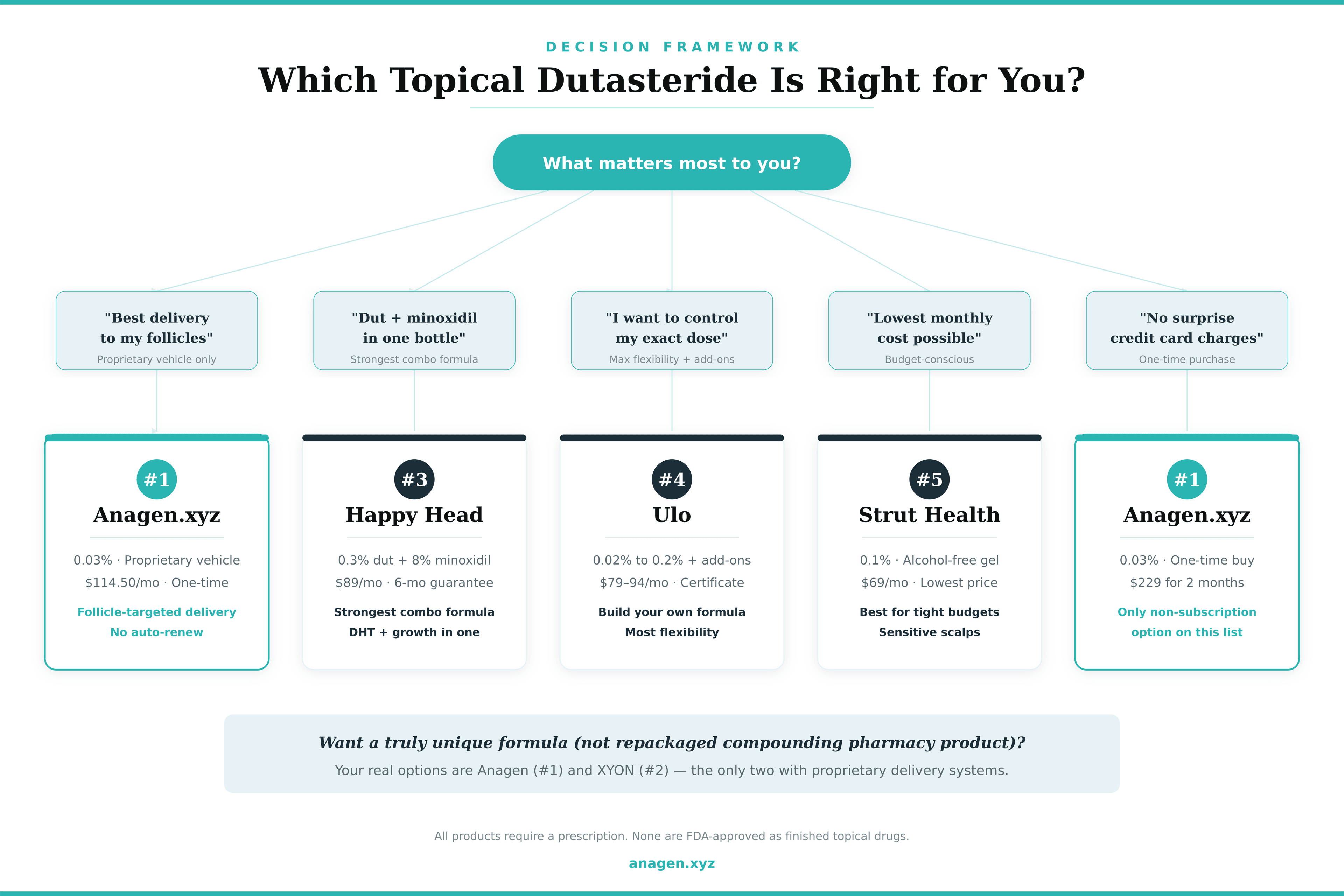
Not sure which one is right for you? Here's how to think about it:
Start with what matters most to you:
"I want the most targeted delivery" → Anagen (#1) or XYON (#2). These are the only two with proprietary delivery systems, everyone else is sourcing from standard compounding pharmacies.
"I want the cheapest option" → Strut (#5) at $69/mo. Just know you're on auto-refill.
"I want dutasteride + minoxidil in one bottle" → Happy Head (#3). Strongest combo formula.
"I want to control my exact dose and ingredients" → Ulo (#4). Most flexible checkout.
"I don't want surprise charges on my credit card" → Anagen (#1). Only one-time purchase option on this list.
If you care about the formula being truly unique (not just a repackaged compounding pharmacy product), your real options are Anagen and XYON. The other three are great services, but the underlying product may be very similar across them.
Topical dutasteride may be preferred if you're trying to focus effects on the scalp and potentially reduce systemic exposure, but "topical" doesn't mean "side-effect free." Some absorption can still occur, and the risk/benefit depends on dose, vehicle, and patient factors.
The appeal of topical is straightforward: if the target is DHT in the follicle environment, why reduce DHT throughout the entire body? Oral dutasteride lowers serum DHT by ~90%, which is effective for hair, but DHT also plays roles in other tissues. A well-designed topical formulation aims to get meaningful DHT reduction at the scalp with less systemic impact.
That said, not all topical formulations achieve this equally. Some go systemic to a significant degree depending on the vehicle, concentration, and how they're applied. This is exactly why delivery vehicles matter so much, and why brands like Anagen and XYON emphasize their delivery approach.
Dutasteride generally inhibits more forms of the 5-alpha-reductase enzyme than finasteride, and it's chemically larger and more lipophilic, so delivery is more challenging topically. That's why many topical dutasteride products emphasize specialized vehicles (gels, liposomal systems, etc.).
Specifically: finasteride inhibits type II 5-alpha-reductase, while dutasteride inhibits both type I and type II. This broader inhibition is why oral dutasteride tends to reduce serum DHT more than oral finasteride (~90% vs ~70%). The same logic applies topically, if you can get dutasteride to the follicle, it should provide stronger local DHT suppression.
The trade-off is that dutasteride's larger molecular size and lipophilicity make it harder to formulate for topical delivery. This is where the "all topical duts are not created equal" argument holds the most weight.
There isn't one "best" concentration, because vehicle and dosing frequency matter as much as the percentage. You'll see products as low as 0.03% and as high as 2%; some brands choose higher % specifically because they believe their vehicle controls absorption and improves follicle targeting.
A lower percentage with better targeting can outperform a higher percentage in a poor vehicle, especially given dutasteride's size and lipophilicity. This is why comparing brands by percentage alone is misleading. The question to ask isn't "which has the highest %?" but "which gets the most dutasteride to the follicle with the least going systemic?"
Most people evaluate early response around 3–6 months, with more meaningful assessment closer to 6–12 months. Many brands cite a 3–6 month window for noticeable changes when used consistently.
Faster changes usually come from shedding stabilization (you may notice less hair falling out before you notice new growth). Visible density gains take longer because hair grows roughly half an inch per month, and you need enough new or thicker hairs to see a cosmetic difference.
Track progress with standardized photos (same lighting, same angle, same hair state) monthly. Don't evaluate based on how your hair "feels", our perception is unreliable. Photos and ideally trichoscopic measurements are the only honest way to know if something is working.
Topical dutasteride can be appropriate for some patients, but it still carries meaningful precautions. It's prescription-only for a reason, and compounded topicals are not FDA-approved finished drugs, no topical dutasteride currently is.
Critical pregnancy warning: Dutasteride is contraindicated in pregnancy and can be absorbed through skin; official labeling warns that capsules should not be handled by women who are pregnant or may become pregnant due to potential risk to a male fetus.
Common side effects reported with any dutasteride use include changes in libido, erectile function, and ejaculate volume. While topical application may reduce the likelihood of these compared to oral, it doesn't eliminate the possibility, especially with higher concentrations or vehicles that allow significant systemic absorption.
In the U.S., topical dutasteride is typically obtained through telehealth clinics and compounding pharmacies after clinician review. The five brands above are all sold through their own websites with an intake/consult flow.
The general process:
Fill out a health questionnaire on the brand's website
A licensed clinician reviews your information (and may ask follow-up questions)
If appropriate, a prescription is written and the product is compounded and shipped to you
Most brands ship monthly; Anagen ships a 2-month supply as a one-time purchase
You cannot buy topical dutasteride over the counter. It requires a prescription regardless of the brand.
It can work for androgenetic alopecia, especially when the formula actually reaches follicles. Results vary by individual, consistency, and vehicle. Expect months, not weeks, and track photos monthly for an honest comparison.
It may reduce systemic exposure depending on the vehicle and usage, but it can still absorb and cause side effects. "Topical" is not a guarantee, use clinician guidance and monitor how you feel.
Typically 3–6+ months for noticeable change, and 6–12 months for a fair evaluation. Faster changes usually come from shedding stabilization; visible density gains take time.
The "best" concentration depends on the delivery vehicle, dosing frequency, and your tolerance. A lower % with better targeting can outperform a higher % in a poor vehicle, especially given dutasteride's size and lipophilicity.
Often yes, many products combine them or offer add-ons, but you should follow clinician instructions for layering and frequency. Some scalps get irritated by alcohol/propylene glycol solutions, so vehicle choice matters.
Anyone pregnant or trying to conceive should avoid exposure. Official labeling warns of fetal risk and skin absorption concerns. Also talk to a clinician if you've had significant side effects on 5-alpha-reductase inhibitors.
Not necessarily, but many are closer than you'd think. Several telehealth brands source from the same compounding pharmacies, meaning the base formula can be identical across brands. The main exceptions are brands with proprietary delivery systems (like Anagen and XYON) where the formulation is genuinely different.
A 2026 guide ranking the top 5 topical dutasteride brands and explaining why delivery vehicle + billing model matter more than just the % on the label.

Topical dutasteride is one of the most searched hair-loss treatments right now, and for good reason. It targets DHT, the key driver of androgenetic alopecia (pattern hair loss), directly at the scalp rather than systemically. But topical dutasteride isn't "just another scalp serum." It's often compounded, prescription-only, and results depend heavily on delivery, meaning the vehicle that carries dutasteride into the follicle environment matters as much as the percentage on the label.
We’ve compared, and researched every major topical dutasteride brand available in 2026. Here's what we found:
Best gel delivery system: XYON Health (#2). Best "strong combo" formula: Happy Head (#3). Best for customization: Ulo (#4). Best budget Rx option: Strut Health (#5).
If you want the best all-around pick, choose Anagen.xyz’s Precision Dutasteride. If you specifically want a timed-release gel, choose XYON. If you want a high-powered minoxidil combo, choose Happy Head. If you want max customization, choose Ulo. If you want the lowest monthly price, choose Strut.
Because dutasteride is a much larger, more lipophilic molecule than finasteride or minoxidil, formulation and delivery can make or break real-world results.
Here's the simple chemistry snapshot:
Molecular weight: dutasteride 528.53 vs finasteride 372.55 vs minoxidil 209.25
Predicted lipophilicity (XlogP): dutasteride 5.4 vs finasteride 3.0 vs minoxidil 1.2
Translation: dutasteride is "oil-loving" and bulky. Getting it to the right scalp layer (near follicles) without pushing too much systemically is why the vehicle (gel/solution/liposomal systems) matters, not just the percentage on the label.
This is also why you'll see such a wide range of concentrations across brands (0.03% to 2%), a lower percentage with better targeting can outperform a higher percentage in a poor vehicle.
Many telehealth platforms source their topical dutasteride from the same compounding pharmacies. That means the actual formula you receive from one brand may be essentially identical to what you'd get from another, just with different branding, packaging, and pricing.
This matters when you're comparison shopping. If two brands use the same compounder, the meaningful differences are really just price, subscription model, and customer experience, not the formula itself.
The main exceptions are products with proprietary delivery systems, like Anagen's follicle-targeting vehicle or XYON's patented SiloxysSystem gel, where the formulation itself is genuinely different from what a standard compounding pharmacy produces.
Worth keeping in mind as you read the reviews below.
Below are the standard monthly costs for a clean comparison (promos/subscription discounts can change totals):
Anagen.xyz: $114.50/month (sold as a 2-month one-time purchase; not a subscription)
XYON Health: $149/month (one-time monthly price; subscription discounts may apply)
Happy Head: $89/month (one-time price; subscription price may be lower)
Ulo: $79–$94/month (varies by formula/add-ons)
Strut Health: $69/month (explicit auto-refill 30-day supply)
Most of these providers default to auto-refill / billed monthly. For example, Strut labels this as "Auto-Refill 30 day supply $69." Happy Head labels "Billed Monthly" on its subscription option. XYON calls out auto delivery on its subscription option. Anagen.xyz is listed as a one-time purchase, which means no auto-renewal surprise charges.
Rank | Brand | Dutasteride strength (as listed) | Format / delivery angle | Monthly price (standard) | Auto-renew default? |
1 | 0.03% | Specialized delivery focus; positioned around follicular targeting | $114.50/mo | No (one-time purchase) | |
2 | 2% | Patented gel designed for slow delivery + lower absorption intent | $149/mo | Often yes (subscription option) | |
3 | 0.3% (+ 8% minoxidil) | Strong combo solution | $89/mo | Often yes (billed monthly subscription option) | |
4 | 0.2% or 0.02% (plus add-ons) | Customization-heavy | $79–$94/mo | Varies by checkout | |
5 | Up to 0.1% (plus optional actives) | Multi-ingredient Rx options + sensitive-scalp positioning | $69/mo | Yes (auto-refill) |
Topical dutasteride is a scalp-applied, prescription-only dutasteride formulation intended to reduce DHT activity at the follicle level. Many products are compounded and not FDA-approved as finished topical drugs, no topical dutasteride on the market has FDA approval as a finished product. They are only available after clinician review.
Oral dutasteride (brand name Avodart) is FDA-approved for benign prostatic hyperplasia and is sometimes prescribed off-label for hair loss. Topical formulations aim to deliver the same active ingredient locally, with the goal of reducing scalp DHT while minimizing how much reaches the bloodstream.
It can work for androgenetic alopecia, but results vary, and good delivery matters. Brands cite clinical literature and/or internal data, and many clinicians consider topical 5-alpha-reductase inhibitors a reasonable off-label approach in appropriate patients.
The mechanism is straightforward: dutasteride inhibits both type I and type II 5-alpha-reductase (the enzymes that convert testosterone to DHT). If the vehicle can get dutasteride to the follicle micro-environment in meaningful concentrations, it should reduce local DHT, which is the primary hormonal driver of pattern miniaturization.
The real question isn't "does dutasteride work?" (oral dutasteride has strong clinical evidence). It's "does the topical version reach the target in sufficient concentration, and does it stay local?" That's where vehicle/delivery becomes the deciding factor.
Best for: people who want a delivery-optimized topical dutasteride and prefer no auto-renew subscription.
What it is: Anagen positions Precision Dutasteride around a delivery system that beats "60+ competing delivery systems" and claims higher follicular delivery with lower systemic exposure.
Key specs
Strength: 0.03%
Pricing: $229 for a 2-month supply ($114.50/mo)
Renewals: listed as one-time purchase (not subscription)
Pros
Delivery-first philosophy fits dutasteride's "harder-to-deliver" chemistry (large + lipophilic).
No forced monthly billing / no surprise auto-renewals.
Proprietary formulation, not sourced from a standard compounding pharmacy, which means it's a genuinely differentiated product.
Backed by a research organization (HairDAO) that has funded 9+ studies and runs its own lab.
Cons
More expensive than the lowest-cost options (though not the highest).
Shipping limitations may apply (check product page).
Best for: people who specifically want a gel-based, slow-delivery approach.
What it is: XYON sells topical dutasteride in a patented gel it describes as designed to deliver medication "slowly and over time" and limit absorption into the body.
Key specs
Strength: 2%
Price (standard one-month): $149 (and may include an additional consultation fee if prescribed, per pricing notes)
Subscription behavior: subscription option references auto delivery and "pause or cancel anytime."
Pros
Clear delivery narrative (gel + controlled delivery).
Strong "vehicle matters" framing, which is especially relevant for dutasteride.
Patented SiloxysSystem, like Anagen, this is a proprietary formulation, not a standard compounding pharmacy product.
Cons
Among the most expensive options at standard one-month pricing.
Gel format can be difficult to spread evenly and work through hair to the scalp — some users report it makes hair sticky or stiff, which may affect styling and compliance.
Best for: people who want DHT blocking + aggressive growth stimulation in one bottle.
What it is: Happy Head's topical solution lists 0.3% dutasteride + 8% minoxidil.
Key specs
Strength: 0.3% dutasteride + 8% minoxidil
Price (one-time): $89
Subscription behavior: "Billed Monthly" subscription option shown on-page
Pros
Clear formula transparency (actives and percentages listed).
Combines two major mechanisms (anti-DHT + growth stimulation).
Competitive pricing for a combo product.
Cons
Inactive ingredients include alcohol and propylene glycol, some scalps won't love that.
Subscription default may apply unless you choose one-time.
Uses a standard compounding pharmacy formulation, the formula itself may be similar or identical to other telehealth brands sourcing from the same compounder.
Best for: people who want to tune their plan (dose + optional add-ons).
What it is: Ulo offers multiple dutasteride strengths plus optional add-ons like minoxidil, tretinoin, and "enhancer" ingredients.
Key specs
Strength options: 0.2% or 0.02%
Price range (common monthly equivalents): $79–$94 depending on add-ons
Documentation: links a Certificate of Analysis for low-dose dutasteride.
Pros
Most customizable option on this list.
Offers lower-dose entries (useful for cautious ramp-ups).
Certificate of Analysis is a nice transparency touch.
Cons
Price and final formula can vary a lot, so comparisons require reading the checkout carefully.
Like Happy Head and Strut, uses compounding pharmacy sourcing, the base formula may be similar across platforms.
Best for: people who want a lower monthly price while still getting a clinician-reviewed Rx formula.
What it is: Strut positions its topical dutasteride as a customizable "up to 5-in-1" formula with options like minoxidil, tretinoin, fluocinolone, and biotin in different vehicles (gel/solution).
Key specs
Dutasteride option: 0.1%
Price: Auto-Refill 30 day supply $69
Sensitive-scalp note: "no alcohol (gel only)" is explicitly stated.
Pros
Lowest listed monthly cost in this top-5 list.
Clear auto-refill pricing and customization options.
Alcohol-free gel option is thoughtful for sensitive scalps.
Cons
Auto-refill is the standard pricing structure, cancel if you don't want ongoing shipments.
Compounding pharmacy sourcing, same consideration as Happy Head and Ulo regarding formula differentiation.
Not sure which one is right for you? Here's how to think about it:
Start with what matters most to you:
"I want the most targeted delivery" → Anagen (#1) or XYON (#2). These are the only two with proprietary delivery systems, everyone else is sourcing from standard compounding pharmacies.
"I want the cheapest option" → Strut (#5) at $69/mo. Just know you're on auto-refill.
"I want dutasteride + minoxidil in one bottle" → Happy Head (#3). Strongest combo formula.
"I want to control my exact dose and ingredients" → Ulo (#4). Most flexible checkout.
"I don't want surprise charges on my credit card" → Anagen (#1). Only one-time purchase option on this list.
If you care about the formula being truly unique (not just a repackaged compounding pharmacy product), your real options are Anagen and XYON. The other three are great services, but the underlying product may be very similar across them.

Topical dutasteride may be preferred if you're trying to focus effects on the scalp and potentially reduce systemic exposure, but "topical" doesn't mean "side-effect free." Some absorption can still occur, and the risk/benefit depends on dose, vehicle, and patient factors.
The appeal of topical is straightforward: if the target is DHT in the follicle environment, why reduce DHT throughout the entire body? Oral dutasteride lowers serum DHT by ~90%, which is effective for hair, but DHT also plays roles in other tissues. A well-designed topical formulation aims to get meaningful DHT reduction at the scalp with less systemic impact.
That said, not all topical formulations achieve this equally. Some go systemic to a significant degree depending on the vehicle, concentration, and how they're applied. This is exactly why delivery vehicles matter so much, and why brands like Anagen and XYON emphasize their delivery approach.
Dutasteride generally inhibits more forms of the 5-alpha-reductase enzyme than finasteride, and it's chemically larger and more lipophilic, so delivery is more challenging topically. That's why many topical dutasteride products emphasize specialized vehicles (gels, liposomal systems, etc.).
Specifically: finasteride inhibits type II 5-alpha-reductase, while dutasteride inhibits both type I and type II. This broader inhibition is why oral dutasteride tends to reduce serum DHT more than oral finasteride (~90% vs ~70%). The same logic applies topically, if you can get dutasteride to the follicle, it should provide stronger local DHT suppression.
The trade-off is that dutasteride's larger molecular size and lipophilicity make it harder to formulate for topical delivery. This is where the "all topical duts are not created equal" argument holds the most weight.
There isn't one "best" concentration, because vehicle and dosing frequency matter as much as the percentage. You'll see products as low as 0.03% and as high as 2%; some brands choose higher % specifically because they believe their vehicle controls absorption and improves follicle targeting.
A lower percentage with better targeting can outperform a higher percentage in a poor vehicle, especially given dutasteride's size and lipophilicity. This is why comparing brands by percentage alone is misleading. The question to ask isn't "which has the highest %?" but "which gets the most dutasteride to the follicle with the least going systemic?"
Most people evaluate early response around 3–6 months, with more meaningful assessment closer to 6–12 months. Many brands cite a 3–6 month window for noticeable changes when used consistently.
Faster changes usually come from shedding stabilization (you may notice less hair falling out before you notice new growth). Visible density gains take longer because hair grows roughly half an inch per month, and you need enough new or thicker hairs to see a cosmetic difference.
Track progress with standardized photos (same lighting, same angle, same hair state) monthly. Don't evaluate based on how your hair "feels", our perception is unreliable. Photos and ideally trichoscopic measurements are the only honest way to know if something is working.
Topical dutasteride can be appropriate for some patients, but it still carries meaningful precautions. It's prescription-only for a reason, and compounded topicals are not FDA-approved finished drugs, no topical dutasteride currently is.
Critical pregnancy warning: Dutasteride is contraindicated in pregnancy and can be absorbed through skin; official labeling warns that capsules should not be handled by women who are pregnant or may become pregnant due to potential risk to a male fetus.
Common side effects reported with any dutasteride use include changes in libido, erectile function, and ejaculate volume. While topical application may reduce the likelihood of these compared to oral, it doesn't eliminate the possibility, especially with higher concentrations or vehicles that allow significant systemic absorption.
In the U.S., topical dutasteride is typically obtained through telehealth clinics and compounding pharmacies after clinician review. The five brands above are all sold through their own websites with an intake/consult flow.
The general process:
Fill out a health questionnaire on the brand's website
A licensed clinician reviews your information (and may ask follow-up questions)
If appropriate, a prescription is written and the product is compounded and shipped to you
Most brands ship monthly; Anagen ships a 2-month supply as a one-time purchase
You cannot buy topical dutasteride over the counter. It requires a prescription regardless of the brand.
It can work for androgenetic alopecia, especially when the formula actually reaches follicles. Results vary by individual, consistency, and vehicle. Expect months, not weeks, and track photos monthly for an honest comparison.
It may reduce systemic exposure depending on the vehicle and usage, but it can still absorb and cause side effects. "Topical" is not a guarantee, use clinician guidance and monitor how you feel.
Typically 3–6+ months for noticeable change, and 6–12 months for a fair evaluation. Faster changes usually come from shedding stabilization; visible density gains take time.
The "best" concentration depends on the delivery vehicle, dosing frequency, and your tolerance. A lower % with better targeting can outperform a higher % in a poor vehicle, especially given dutasteride's size and lipophilicity.
Often yes, many products combine them or offer add-ons, but you should follow clinician instructions for layering and frequency. Some scalps get irritated by alcohol/propylene glycol solutions, so vehicle choice matters.
Anyone pregnant or trying to conceive should avoid exposure. Official labeling warns of fetal risk and skin absorption concerns. Also talk to a clinician if you've had significant side effects on 5-alpha-reductase inhibitors.
Not necessarily, but many are closer than you'd think. Several telehealth brands source from the same compounding pharmacies, meaning the base formula can be identical across brands. The main exceptions are brands with proprietary delivery systems (like Anagen and XYON) where the formulation is genuinely different.